
In the experiment: LG SJ9 soundbar offers Atmos and sound quality

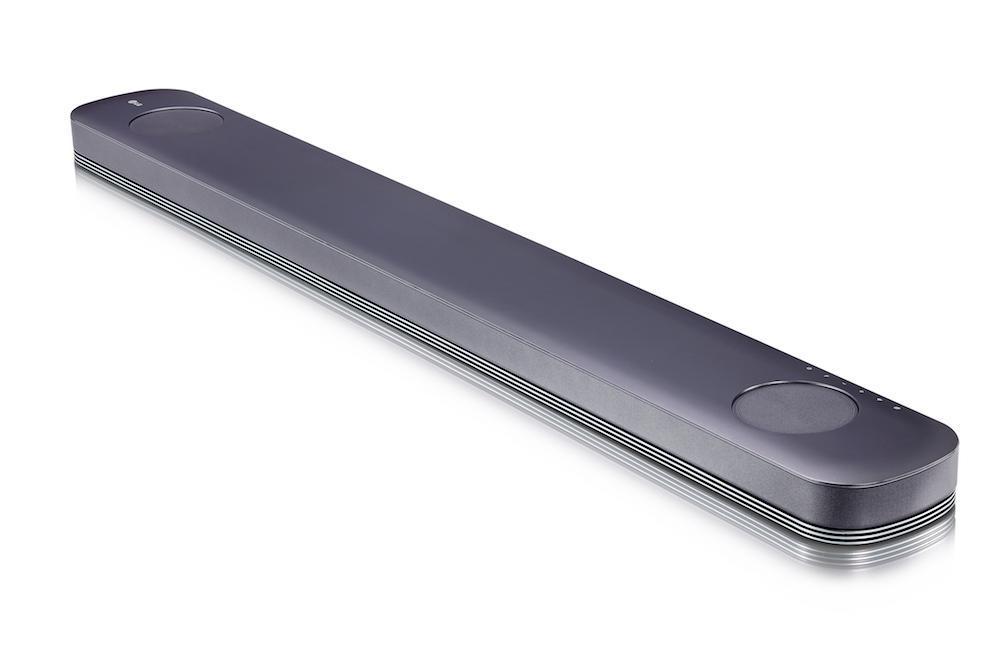
LG has been investing in sound quality for just under a decade – to be exact, since Mark Levinson (a man, not a brand) began his work at the manufacturer’s factory. Although the collaboration has already ended, LG has kept its course and has also received praise for the audio capabilities of its devices in the process.
Text: Magnus Fredholm / Photos: HemmaBio & Producer
Published in AVPlus magazine 8/2017.
LG has described itself as focusing strictly on the mid-range of the audio spectrum, and especially the ASC (Adaptive Sound Control) has received a lot of attention. This feature should optimize the playback to match the material, and without going into too much detail at the outset, we can say that the SJ9 soundbar really works and performs well!
Different appearance
The SJ9 is the flagship model in LG's soundbar lineup, which doesn't differ much in appearance from the manufacturer's flagship ultra-slim Signature W OLED TV. Of course, the SJ9 looks a little simpler in appearance, as it lacks distinctive speakers to create a smooth, minimalist impression. It offers a 5.1.2 soundfield (virtually, but still) and can be installed on any television.
The closest comparisons to the SJ9 are, for example, last year’s Samsung HW-K960 or the Philips Fidelio B8, but the devices differ from each other at least based on the selling price. While the general selling price in Finland for the Samsung is about 1,500 euros and the Philips is sold for about a ton, the price of the LG SJ9 is tight at 899 euros.
Everything you need
The LG SJ9 is a soundbar that offers practically everything needed in its product category: it decodes all formats and includes all possible connections, including ARC and multi-room support. However, someone might in some cases need more than one HDMI connection, coaxial input, and USB – and to enable a more authentic surround sound experience, genuine, preferably wireless rear speakers. However, those willing can connect the LG Music Flow multiroom feature to the system using, for example, the LG H3 speakers, which cost just over a hundred from LG.
The main purpose of the LG SJ9 is to provide its users with better TV and movie sound quality, and to expand the music services in the living room as well.

Install and connect
The traditional way to place an SJ9 is to place it on a TV stand, but there are also brackets for wall mounting included. It is recommended to place the subwoofer on the floor in the same wall as the TV, and preferably near the screen as well. The reason for this is that the subwoofers used with soundbars often reproduce high frequencies to such an extent that their direction can be perceived in the room. Therefore, direct front-firing is a better option for the atmosphere.
We tested the SJ9 with several different TVs via the HDMI connection, but we also tried a wireless connection compatible with LG TVs. That’s of course a nice feature, but since we also used Blu-ray movies (in UHD format as well) as the test material, the HDMI connection is a must. And for clarification’s sake, the ability to connect the UHD Blu-ray player directly to the TV and play the audio from it wirelessly to the soundbar is indeed great, but then the Dolby Atmos audio track doesn’t reproduce properly, which again defeats the purpose of the SJ9.
To test the whole thing, we connected the SJ9 to a Sony UBP-X800 UHD Blu-ray player, an Ethernet cable, a TV with an optical connection, and left the cable connected to the aux input for testing with a portable music player. The aux input located on the back of the unit looks a bit strange, as the solution cannot be considered particularly easy or quick for quick connection of additional devices.


Created surround sound
The LG SJ9, as mentioned, is a 5.1.2 channel soundbar. The three channels are easy to identify: the left, middle, and right channels point directly forward. The .1 channel is also easy to understand, as it has a subwoofer placed separately on the floor, and the .2 channels themselves are not particularly difficult to understand, as they are embedded in the device and play quite awkwardly as Atmos channels. But what about the two surround channels coming from behind the listener in the 5.1.2 system?
Well, in this case LG’s solution is quite interesting – in an exceptionally effective way. Instead of the sound coming from the side of the device and reflecting off the walls to the listening point, the SJ9’s magic is based on DSP echoes. This way the sound does indeed feel coming from behind the listener, but without the need for the reflective wall surfaces. Not bad!

Good audio manipulation
We decided to start by feeding the player something other than Deadpool, something that best brings out the Atmos playback, namely an official Dolby Atmos demo disc. It soon became apparent that the SJ9 does a good job of playing the Atmos channels: the audio is impressive and it immerses the listener.
Clearly, no sound comes from the rear, but the playback is still surprisingly well-positioned to come from the soundbar. The separation between the left, middle, and right channels is quite exemplary. Based on the test disc, the subwoofer also seems to function quite well – not particularly well, but simply as it should be.
While exploring the mid-range sound emphasized by LG, we repeated selected scenes from the film Alone in Mars. And as you might expect, the mid-range register was well balanced throughout without unnecessary emphasis.
To get a baseline for comparison, for example, with the Philips Fidelio B8, whose center frequency sits a little better for movies than for music, we also listened to a bunch of songs by artists such as Steve Earle, KT Tunstall, XTC, Jonathan Brooke, Joe Ely and The Beatles.
The music playback from the SJ9 was very smooth, especially when we listened to the sounds that we were already familiar with through it. And yes, the mid-range reproduction on the SJ9 is truly on point! And what’s weird is that it seemed to be at its best with the ASC feature turned on. There were no extra tones in the playback (although for the sake of honesty, the after-effect wasn’t exactly faithful to the original), and actually the overall feel was quite pleasant.
The ASC feature is worth keeping on, actually, constantly.
Most read today
Latest
Subscribe to the newsletter
Subscribe to our newsletter and stay up to date with the latest news in technology and entertainment electronics.
Survey
Quiz
Nokia phones
Related Posts

TESTISSÄ KAIKU WAVE wireless noise cancelling headphones – a Finnish challenger in the tough premium category
The Kaiku Wave is a wireless noise-canceling headset costing 449 euros, combining partly Finnish design, Finnish wood, restrained design, long battery life and...

Philips The Roller and The Tube – Moving sound with its own style
Philips The Roller and The Tube bring back the 1980s boombox spirit without cassettes or radio. It comes with Bluetooth, a battery, Auracast, and...
Cayin Jazz 70 – genuine tube sound and style at a reasonable price
The tube amplifier doesn't need to cost several thousand euros. The new Jazz 70 from Cayin brings classic EL34 tube technology, visible tubes, analog meters, and hand-crafted controls...

The use of artificial intelligence in music is growing rapidly, but there is still a lot to be learned about its use – at least in Finland.
Artificial music evokes significantly more reservations in Finns than the use of artificial intelligence in general. Artificial intelligence is rapidly becoming a part of everyday life, but the output it produces...
The new arrival of CDs is also reflected in devices – the Argon Audio CD1 is a new CD player priced at 399 euros
The arrival of vinyl records has been ongoing for a long time, and now a similar trend is also evident in CD records. Argon Audio responds to this interest with the new CD1 player,...

Audio-Technica ATH-AL5NC combines an open design and wireless connectivity – battery life up to 75 hours
Audio-Technica expands its range of open headphones with the ATH-AL5NC model, which is the manufacturer's first wireless open headphone. In addition to Bluetooth connectivity, it also features LDAC, noise reduction, and sound leakage...
 Suomi
Suomi  English