
Test: Harman Kardon SoundSticks 5-2.1 active speakers – A design classic brought up to date


Design classic brought into the modern age
The Harman Kardon SoundSticks are one of the longest-lasting audio products, with their basic design having remained recognizable for decades.
The series dates back to 1999, when Apple and Harman Kardon introduced the transparent iSub subwoofer for the iMac. The actual SoundSticks speakers were released the following year, in July 2000 at Macworld. The original SoundSticks was a 2.1 speaker system, which, as the name suggests, had two narrow, ribbon-like “sound bars” as satellite speakers and a separate iSub subwoofer.
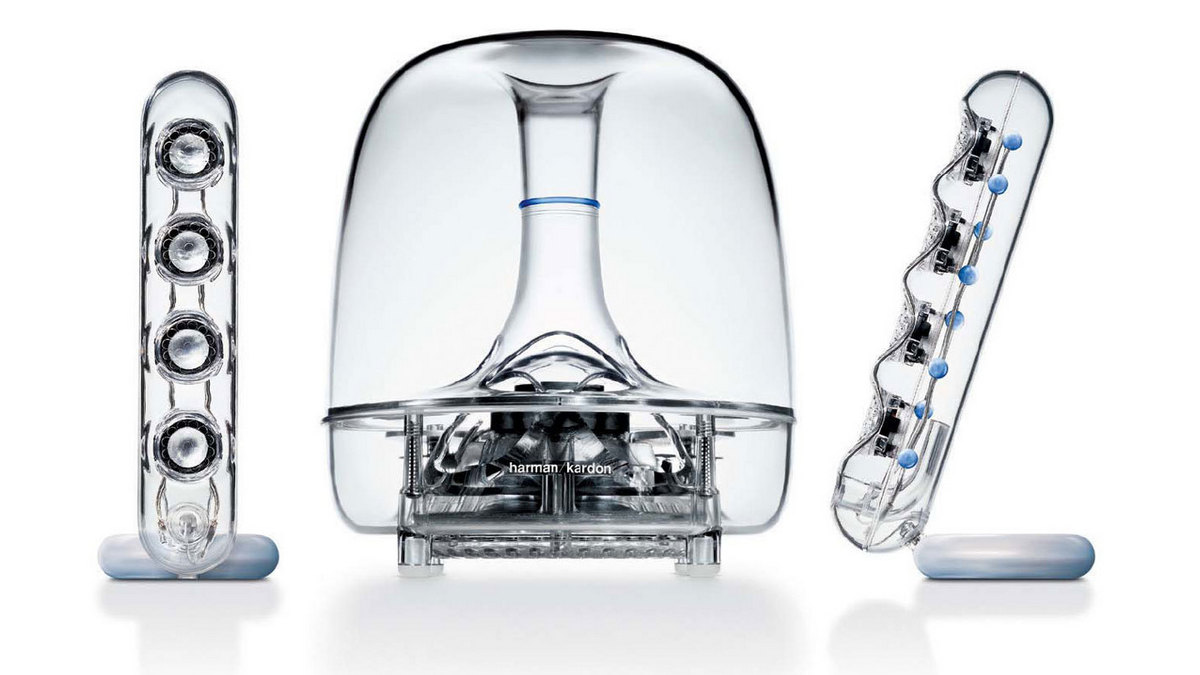
The transparent design matched the visual world of the era's iMac computers, and the iSub later ended up in the collections of the Museum of Modern Art in New York as well.
The design and basic concept of the SoundStick have remained largely unchanged, although the technology has been updated several times. The SoundSticks II introduced 3.5mm analog input in 2004 instead of the original USB connection, the SoundSticks Wireless added Bluetooth in 2012, and the SoundSticks 4 was the first major external update in the lineup in 2020.
Two versions
The latest SoundSticks 5 generation is divided into two versions: SoundSticks 5 and 5 Wi-Fi. The “basic version” has a 3.5 mm line input, Bluetooth and HDMI ARC for the TV. The SoundSticks 5 Wi-Fi has a line input and Bluetooth, plus a built-in streaming player that includes all the major streaming services, including AirPlay, Google Cast, Spotify Connect, Tidal Connect, etc. However, there is no HDMI ARC connection. In our opinion, this is a somewhat strange choice.
There is also a difference in prices, but they vary from retailer to retailer. The SoundSticks 5 Wi-Fi costs around 379–429 euros, while the Harman Kardon model on their own website costs 379 euros. The basic model of the SoundSticks 5 with an HDMI ARC connection costs around 279–329 euros, while the Harman Kardon website prices it at 329 euros. In practice, the additional cost for the Wi-Fi version is therefore around 50–100 euros. If you primarily use Bluetooth, analog audio, or the sound of the TV, the basic model may be a more reasonable choice. Otherwise, the models are technically similar.
The structure is familiar, the technique is new
The SoundSticks 5 Wi-Fi looks very familiar to SoundSticks. The whole thing consists of two narrow pillar-shaped transparent satellite speakers and a separate (almost) transparent subwoofer. The satellites are lightweight and discreet, but the subwoofer is clearly the larger component of the whole.
The satellites have three 40 mm mid-range drivers in each unit and one 25 mm soft dome tweeter. The subwoofer has one downward-facing 5.25-inch driver. The enclosure is closed.
The manufacturer uses the term "3-way" in its marketing for the structure, but in practice the SoundSticks are actually a 2.1-channel active speaker system with satellite speakers and a subwoofer.
The total power output of the speaker system is stated as 190 watts RMS (1 % THD), which can be considered a very realistic figure and even more than sufficient for its intended use.
The subwoofer unit includes the electronics and all the connections. The satellite speakers are connected to the subwoofer using fixed cables about 1.5 m long. This of course sets limits for the placement of the speakers and subwoofer. Therefore, the speakers cannot be placed very far from the subwoofer. On a desktop setup, this probably won’t be a problem, but if the speakers are placed in the living room to watch TV, longer cables might be necessary.
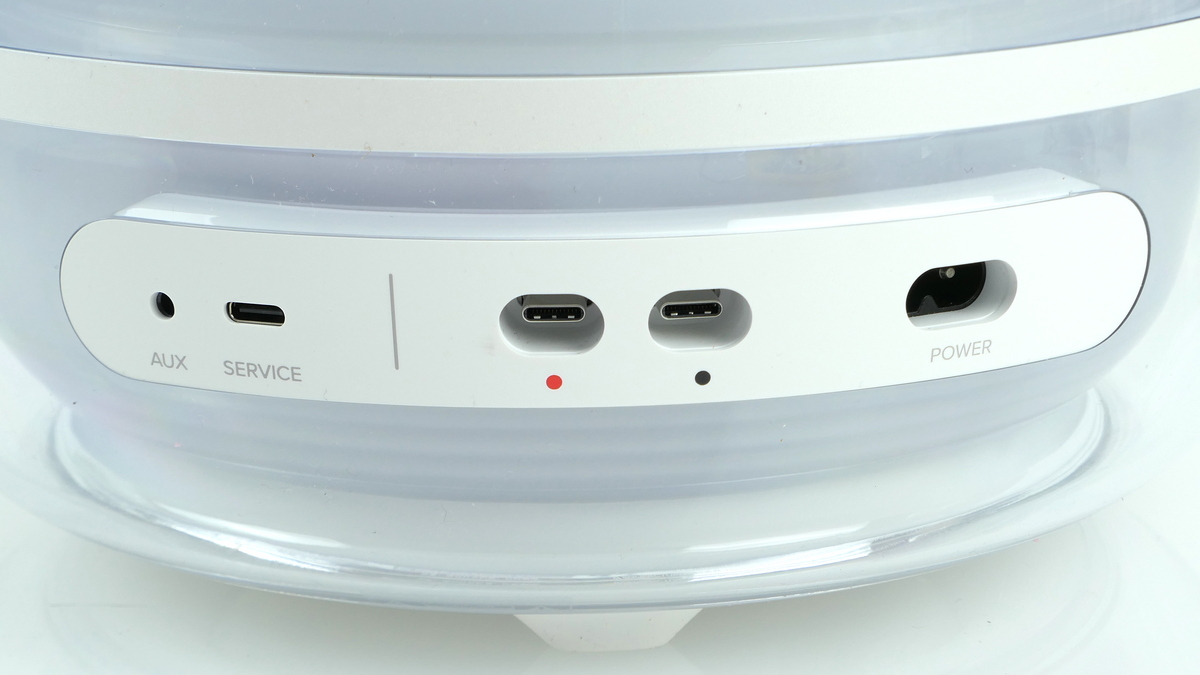
In this Wi-Fi model, there is only one physical input (3.5 mm jack) and you can play music wirelessly via Bluetooth. In addition, the device has Auracast support. Auracast is therefore a Bluetooth LE Audio-based technology that allows audio to be shared between compatible devices without traditional Bluetooth pairing. And there’s also a USB-C port, but for some reason in the European version it only functions as a “service port”. Those other two "USB ports" are for satellite speakers.
Use
SoundSticks 5 Wi-Fi setup takes place after the connections are made using the Harman Kardon One app. The app guides you through connecting the speaker to your home network, after which you can play music from the available streaming services. The setup went smoothly and there’s no need to create a separate account, but of course, the streaming services require their own service and device-specific credentials, naturally.
Operation mainly takes place via the app. The only physical control is possible via the touch buttons on the stand of the second satellite speaker for volume control, Bluetooth connection, and the use of enhanced lighting and background sounds.



There is no actual separate input selection, but priority is given to the network playback and the aux input is automatically selected when a signal is received. And when the Bluetooth is turned on, this works in principle quite naturally, but the solution is not as clear as manually selecting the input/program source.
Those of us who are still using remote controls will miss having a small, ordinary one. It would be a welcome addition, especially for quick control of volume, source, lights and background sounds without using a phone. Now, with SoundSticks, we are often dependent on the phone and its app. That means we often have to install it for the whole family.
Sound quality
The SoundSticks 5 Wi-Fi sound very full for its size and intended use (with some reservations, though). The sound is larger than its size, which is in line with the expectations of a speaker. It has width, weight, and easy listening quality, which fits well with the device’s lifestyle nature.
The biggest strength is the stereo image produced by the separate satellite speakers. When the speakers are placed at a distance that is sufficiently wide, the sound does not remain confined to a single point, but opens up clearly and expansively between the speakers. This is particularly useful in desktop use, where the listening distance is short and the satellites can be placed on both sides of the screen. There was no separate stereo image extension for the application, so the spacious effect is primarily based on the physical placement of the speakers.
The mid-range is at its best clear and easy to listen to. The vocals, speech, and acoustic instruments are reproduced clearly and distinctively, but the sound is not overly bright. The treble is distinct enough, but does not take center stage. Overall, it’s not analytical or completely neutral in a hi-fi sense, but when adjusted it’s pleasant and works for its intended purpose. But...
With the factory settings, the SoundSticks 5 Wi-Fi isn’t at its best. The default Signature setting emphasizes the bass too much. In this case, the sound may initially sound impressive, but soon you notice that the bass covers the mid-range and makes the whole thing heavy, even grating. The other presets also don’t fix the problem. Of course, the placement of the subwoofer also plays a role, but the bass level is still too loud.
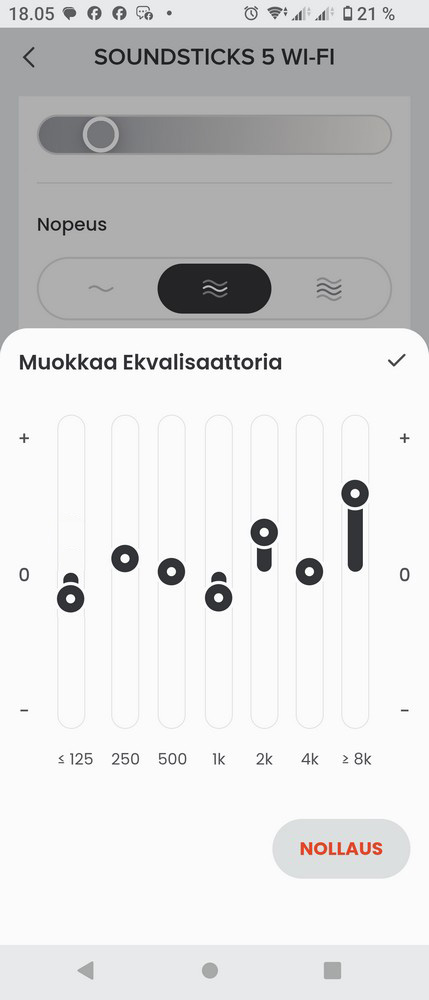
Unfortunately, there is no separate level adjustment for the subwoofer, so the bass volume cannot be adjusted directly by lowering the subwoofer level. Fortunately, the sound can be modified using the Harman Kardon One app’s Custom equalizer. In the test, the best result was achieved with the setting that significantly lowered the bass and upper bass regions and slightly increased the upper frequencies.
Once the bass boost was brought under control, the SoundSticks sounded noticeably better. The mid-range opens up, the vocals stand out better, and the overall balance becomes more natural. The subwoofer still adds weight to the sound, but no longer covers up other frequencies in the same way. When adjusted, the overall performance is better, although the speaker in the very lowest bass range does not perform as well as a system of this size in this class.
The SoundSticks 5 Wi-Fi target group probably has many users who expect the device to sound great without having to adjust the equalizer separately. Many may not even notice the settings. Therefore, the default bass gain settings are a special choice. This also weakens the overall sound of the speaker, because the speaker can perform much better when the sound is adjusted to its proper level.
Lights and background sounds
And that's not all. The SoundSticks 5 Wi-Fi isn't just a sound system; it also features enhanced lighting and separate background sounds.
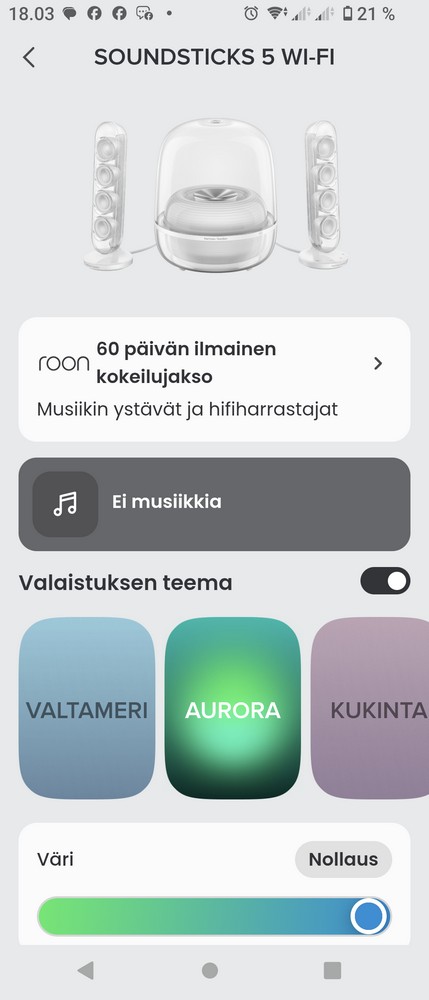
The transparent design is emphasized by the built-in lighting. The lights can be turned on or off from the speaker’s own touch button, and the lighting modes can be switched with a double press of the button.
In the app, you can choose from several lighting effects. You can adjust the lights to fit the device's overall look, or keep them subdued if you don't want the speaker to stand out too much from the surroundings.
The app allows you to choose the speaker to play various background sounds as well, such as rain, sea, or forest sounds. In some of them, you can even adjust individual elements: for example, how loud the rain sounds, whether there are other natural sounds like a rustle or other noises from nature. This sounds special on paper, but in practice the function may not be entirely pointless. A peaceful forest background sound could be perfect for when you go to bed.
Lights and background sounds and their necessity certainly divide opinions. They are not strictly related to the music playback, but depending on the use case and purpose, they can be a good addition.
Most read today

Latest
Subscribe to the newsletter
Subscribe to our newsletter and stay up to date with the latest news in technology and entertainment electronics.
Survey
Quiz
Nokia phones
Related Posts

TESTISSÄ KAIKU WAVE wireless noise cancelling headphones – a Finnish challenger in the tough premium category
The Kaiku Wave is a wireless noise-canceling headset costing 449 euros, combining partly Finnish design, Finnish wood, restrained design, long battery life and...

Philips The Roller and The Tube – Moving sound with its own style
Philips The Roller and The Tube bring back the 1980s boombox spirit without cassettes or radio. It comes with Bluetooth, a battery, Auracast, and...
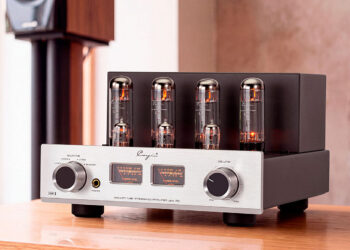
Cayin Jazz 70 – genuine tube sound and style at a reasonable price
The tube amplifier doesn't need to cost several thousand euros. The new Jazz 70 from Cayin brings classic EL34 tube technology, visible tubes, analog meters, and hand-crafted controls...

The use of artificial intelligence in music is growing rapidly, but there is still a lot to be learned about its use – at least in Finland.
Artificial music evokes significantly more reservations in Finns than the use of artificial intelligence in general. Artificial intelligence is rapidly becoming a part of everyday life, but the output it produces...

The new arrival of CDs is also reflected in devices – the Argon Audio CD1 is a new CD player priced at 399 euros
The arrival of vinyl records has been ongoing for a long time, and now a similar trend is also evident in CD records. Argon Audio responds to this interest with the new CD1 player,...

Audio-Technica ATH-AL5NC combines an open design and wireless connectivity – battery life up to 75 hours
Audio-Technica expands its range of open headphones with the ATH-AL5NC model, which is the manufacturer's first wireless open headphone. In addition to Bluetooth connectivity, it also features LDAC, noise reduction, and sound leakage...
 Suomi
Suomi  English