
In the experiment with the Pro-Ject CD Box RS2 T & Pre Box RS2 Digital: ”Every home is high-end”

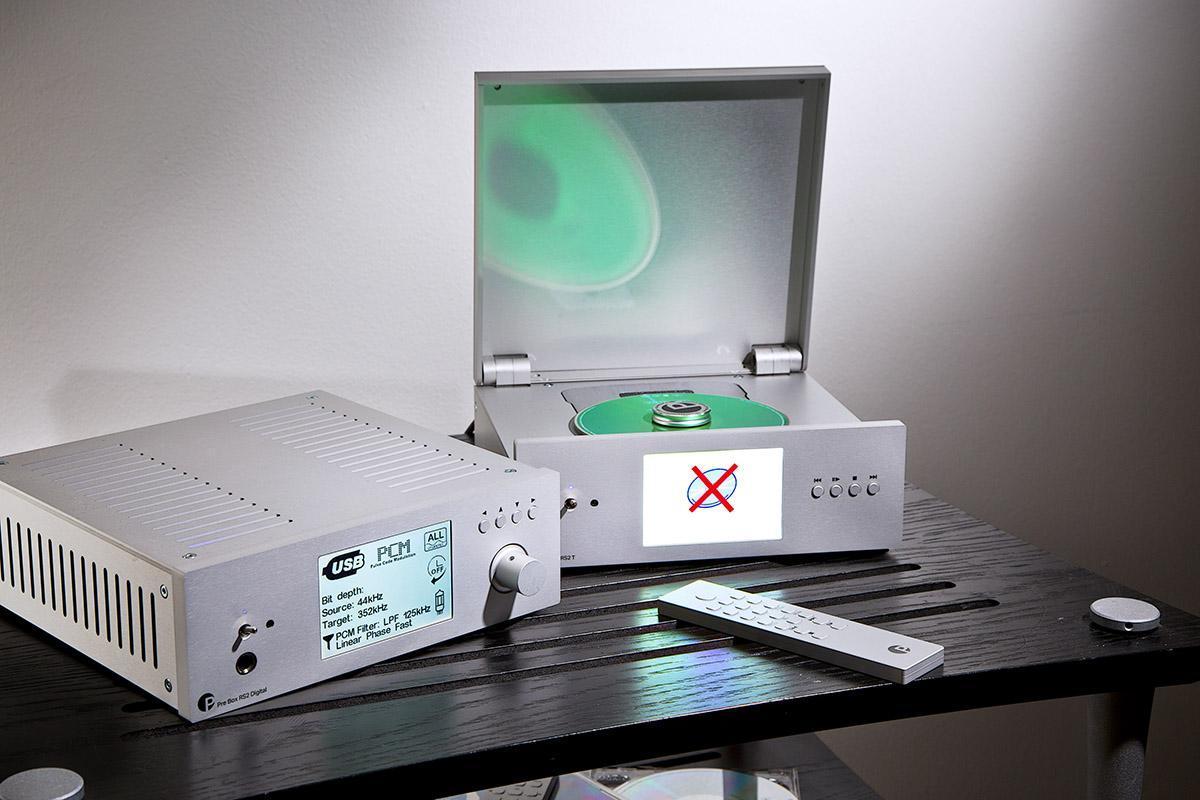
The Pro-Jectin CD Box RS2 T and Pre Box RS2 Digital combo device combo won the EISA award last year in the category of best digital source. Was it a political choice, or is the duo really worth their praise? We have the answer!
Text: Olle Linder & AVPlus editorial team
Photos: Hifi&Musik
What comes to mind first when talking about Pro-Ject? Most people will probably think of functional and relatively affordable vinyl turntables. It’s these that the brand is known for and on which it relied even back when CDs were playing on a home stereo.
But Pro-Jection's resume is much more diverse. Just by looking at the catalog of AH-Hifisystems Oy, the Finnish importer of the brand, you can see that there are almost 50 vinyl turntables alone. There are six different lines of various auxiliary devices. Although most of the lineup consists of mid-range equipment, there is also a more uncompromising section – for example, the CD player CD Box RS2 T and the preamp-amplifier preamplifier–converter Pre Box RS2 Digital, the combined price of which already amounts to 4,490 euros.
In a traditional group
Nowadays, many people consider CD players as a matter of course. In reality, however, they are still being produced in fewer and fewer quantities, and record sales have been in a significant decline for a long time. As a result, the availability of the various components required for their production has also deteriorated. Even the classic series of CD players is no longer readily available.
For example, Philips developed and manufactured some of its players in Vienna at the time. This activity was later transferred to StreamUnlimited, which, in turn, Pro-Ject, which also operates on the outskirts of Vienna, says it produces the best devices that comply with the original Red Book standard. According to the standard definition, the technology’s bit depth is 16 and the display frequency is 44.1 kilohertz. Many other manufacturers, however, rely on the DVD mechanism designed for computers in their CD players.
The mechanism in the Pro-Ject CD player is called the CD Pro-8. It is a plug-in solution with a magnetic disc holder that keeps the disc in place. Similar implementations can be found, among others, from Bryston, Krell, Naim and others; in other words, we are in good company. The package, with its beautiful aluminum casing and carbon fiber base, is also really cool. We are really far from the clunky computer systems here.
The CD Box RS T2 itself is a fairly straightforward turntable. The back only features audio inputs and a power connection. This same spartanship is evident throughout the player. To change a record, you have to manually open the front lid, as there is no remote-controlled hydraulic mechanism or damping. This is therefore extreme manuality, and the same continues on the front panel. The power is connected via a simple lever switch, and on the right side of the simple display there are four control buttons – for starting and stopping playback, as well as for changing tracks forward and backward.
However, one detail is quite interesting: the hdmi connection on the back panel is labeled i2S. This is a digital output that includes an external DA converter for the clock, which can also control the player’s own clock. Although there is no established standard for this technology, some manufacturers use the PS Audio implementation.
We believe that this output should be used. We actually did a comparison with the insanely successful test winner, the Pioneer 668DV, and the Pro-Jet implementation with HDMI took a longer time. The audio image was better, and the playback was smoother.
Versatile digital mill
If the Pro-Jectin turntable is a simpler representative of the duo, the Pre Box RS2 Digital offers more features. It can be used as an preamp with two analog inputs, in RCA or XLR format. Filters are available both digitally and analogically. We generally used the ”Minimum phase, slow” setting, which made the sound a bit softer. The buffer can be driven either with transistors or tubes, which are available in four forms of 6922. Wireless connectivity is available either wirelessly or via cable, and there are a total of six different digital inputs. The front panel features a power switch, headphone jack, volume control, display, and four navigation buttons.
We also listened to the Pre Box RS2 Digital with headphones. The headphone connection worked well, at least with the Sennheiser HD800 – and even better when using the original cable as a slightly better option. The device’s line connection does not mute when the headphones are connected, so for wire listening, it’s a good idea to turn the power amplifier off.
The da converter in the Pre Box RS2 Digital uses two ESS9038Q2M chips. They are familiar from so many contexts that it’s difficult to have a proper opinion about them. And the choice of them does not guarantee anything in terms of the overall performance.
The silver ball continues to shine
During the testing period of the equipment duo, we rotated a lot of CDs, and the implementation according to the Red Book standard hasn’t really suffered over time, even though, for example, Roon is still hot. The playlist included original versions of Alan Parsons Project, Dire Straits, Mike Oldfield, Al di Meola, and Radiohead. And when was the last time you listened to R.E.M.? We enjoyed the well-produced rock of the era before the loudness wars – performed by live musicians.
Our reference DA converter has a two-decibel-stronger output, and it would be easy to assume that it would offer more in the way of dynamics. However, the Pro-Ject duo is a well-behaved contender, with a great balance between transients and the richness of the sound. Compared to that, the Chord Mojo sounded a little rough and a bit too punchy. The Pro-Ject offered a more harmonious and naturally flowing sound. At the same time, however, the duo is quite analytical, as some of the old Mercury Living Presence records sounded quite sharp and the punch of the Decca albums felt real.
Streaming is also possible
We have become accustomed to using the Roon app directly from the computer without a separate streamer. Since the RS2 device pair we tested now only has a CD player and a DA converter, we decided to pair them with the Pro-Ject Stream Box S2 Ultra. Although this device represents the manufacturer’s simpler lineup, it also has its own interesting features, such as the ability to reduce jitter.
Surprisingly, the Stream Box S2 Ultra managed to squeeze even more out of the da converter in the Pre Box RS2 Digital. The reproduction gained more dimension, and the sound image was even more refined. For example, the stereo effect of choral music became more pronounced than in the traditional channel separation.
What is The Clash's best song? Complete Control or White Man in Hammersmith Palais? The first one has good bass lines, while the latter has more structure and the whole band plays together nicely. And that wins out, because the latter is in a completely different league than the reference album. Now we're really on the right track.
But what influences the sound the most? In our opinion, the effect of the digital filters is the least noticeable. Instead, the way the connections between the CD player and the DA converter are arranged means more – and in this respect the hdmi/i2S wins. However, what matters most is that the DA converter’s operating conditions are in order. Using an external streamer instead of a PC increases the power of the Pro-Ject DA converter at least. Thus, it doesn’t really matter whether you’re playing a rough 77-point or the magnificent records of Opus 3, because the overall sound is larger and cleaner.
With pipes or with turbines?
When talking about analog output, there was no significant difference between the tube and transistor implementations; however, if we had to choose, the tubes sounded more pleasant. Both had a warm sound, mainly in the sense that there was no noticeable roughness in the reproduction. However, with the tube option, the overall sound image was larger, more accurate, and more distinct in terms of the ability to present different instruments.
We used a separate preamp throughout the test, but we decided to experiment with how the da converter behaves if it is connected directly to the relatively low input impedance of the main amplifier. With tubes, the result was not as desired because the output impedance of the tube space is higher (220 ohms) than that of the transistors (180 ohms). The tube option therefore was not sufficient on its own to drive the main amplifier.
We were a bit missing the ability to adjust the volume or set the output level to a fixed volume. Now the Pre Box RS2 Digital had to be turned all the way up, and even then we would have wished for more power. Additionally, we wondered why there was no indicator on the display for adjusting the volume.
The CD Box RS2 T didn't really have anything to complain about except that it was a bit noisy for some records. The two tracks on Harmonia Mundi skipped a little, whereas the old Pioneer didn't have any problems reading them. But on the other hand, it didn't sound as good either.

 The ambitious mechanism developed by the Austrian company StreamUnlimited is based on the continuous feeding of the disc and a carbon fiber baseplate that is insulated by a sleeve made of milled aluminum with spiral springs.
 Since there is no music service in Japan that offers uncompressed or even less high-resolution music, the files are mostly downloaded to memory sticks. However, Universal in Japan has released music in the cd-record format that we listened to during the test. The playback was very good and completely advanced, as the da converter played 24-bit and 384-kilohertz files without any problems.
 Pyörit offers several connection options, including aes/ebu, optical toslink, coaxial s/pdif, and also i2S, which is implemented via hdmi. Corresponding connections can also be found in the DA converter–preamp, which also has USB-B, Bluetooth, as well as balanced and unbalanced line inputs and outputs. Both devices operate with an external power source.
 Even on a monochrome display, there is plenty of information, and navigating is not difficult either.
Most read today
Latest
Subscribe to the newsletter
Subscribe to our newsletter and stay up to date with the latest news in technology and entertainment electronics.
Survey
Quiz
Nokia phones
Related Posts
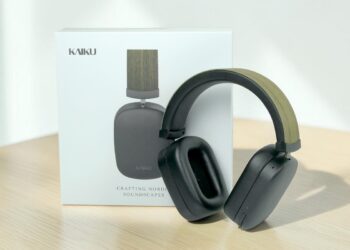
TESTISSÄ KAIKU WAVE wireless noise cancelling headphones – a Finnish challenger in the tough premium category
The Kaiku Wave is a wireless noise-canceling headset costing 449 euros, combining partly Finnish design, Finnish wood, restrained design, long battery life and...
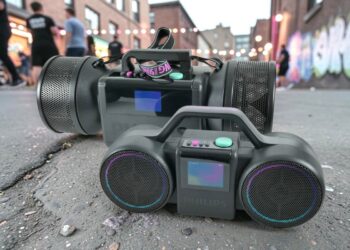
Philips The Roller and The Tube – Moving sound with its own style
Philips The Roller and The Tube bring back the 1980s boombox spirit without cassettes or radio. It comes with Bluetooth, a battery, Auracast, and...
Cayin Jazz 70 – genuine tube sound and style at a reasonable price
The tube amplifier doesn't need to cost several thousand euros. The new Jazz 70 from Cayin brings classic EL34 tube technology, visible tubes, analog meters, and hand-crafted controls...

The use of artificial intelligence in music is growing rapidly, but there is still a lot to be learned about its use – at least in Finland.
Artificial music evokes significantly more reservations in Finns than the use of artificial intelligence in general. Artificial intelligence is rapidly becoming a part of everyday life, but the output it produces...
The new arrival of CDs is also reflected in devices – the Argon Audio CD1 is a new CD player priced at 399 euros
The arrival of vinyl records has been ongoing for a long time, and now a similar trend is also evident in CD records. Argon Audio responds to this interest with the new CD1 player,...
Audio-Technica ATH-AL5NC combines an open design and wireless connectivity – battery life up to 75 hours
Audio-Technica expands its range of open headphones with the ATH-AL5NC model, which is the manufacturer's first wireless open headphone. In addition to Bluetooth connectivity, it also features LDAC, noise reduction, and sound leakage...
 Suomi
Suomi  English