Factory-installed car audio systems often leave something to be desired, especially in terms of low frequencies. However, solutions are available to remedy the situation.
Text: Joni Nikkola & Teppo Hirvikunnas
Photos: Teppo Hirvikunnas and the manufacturer
The standard car audio system rarely provides enough bass for bass enthusiasts. In bass reproduction, the car has the advantage that the cabin dimensions are smaller than the wavelength of the bass wave. For example, a 40 Hz sound wave is 8.5 meters long. Thus, the movement of the bass element directly modulates the diaphragm. In addition, it is easier to make the bass sound good in the car than higher frequencies, because the bass is not directional unlike the mid- and treble frequencies, which must be directed towards the listening points. On the other hand, the disadvantages of the car are the space required for the bass element and the enclosure, as well as the vehicle's noise, which largely competes with the bass in the same frequency band.
One way is to upgrade the loudspeakers that come standard to better ones. By improving the damping, you may also be able to bring out the low-frequency range that has been buried under the noise, allowing the entire frequency range to come into its own better.
However, the standard elements are of small size and generally do not sound very low, leaving the subwoofer as the solution. In the ideal case, the subwoofer does not stand out from the rest of the sound system; it only provides additional support for the rest of the audio system. When well adjusted, the whole sound is like one big sound – only more full-bodied and punchy.
If you want to approach the matter properly, you can build a speaker unit with a housing and purchase an amplifier suitable for it. There are also so-called free air subwoofer elements that do not require a housing. This way, you can influence the final result by choosing the amplifier and the element, as well as by sizing the possible housing. You can go as far as you want in fine-tuning, while at the same time learning, for example, how to build and design a speaker enclosure.
If the design philosophy of the enclosure doesn’t inspire you, the easiest way to fix the low-frequency sound is to build an active subwoofer. It comes in one package with both the subwoofer element and the amplifier. All that’s left is to pull the wires and make the adjustments. You can also customize the setup to your liking if you want to. You can also outsource the installation.
There are subwoofers that can be placed under the seat, but they usually don’t allow for the best possible reproduction. Another invisible solution is models that are placed in the spare wheel housing, where the slightly larger housing size of the subbaric box itself is an advantage. If you crave the best bass reproduction, you will often have to sacrifice a part of the trunk for the subbaric box.
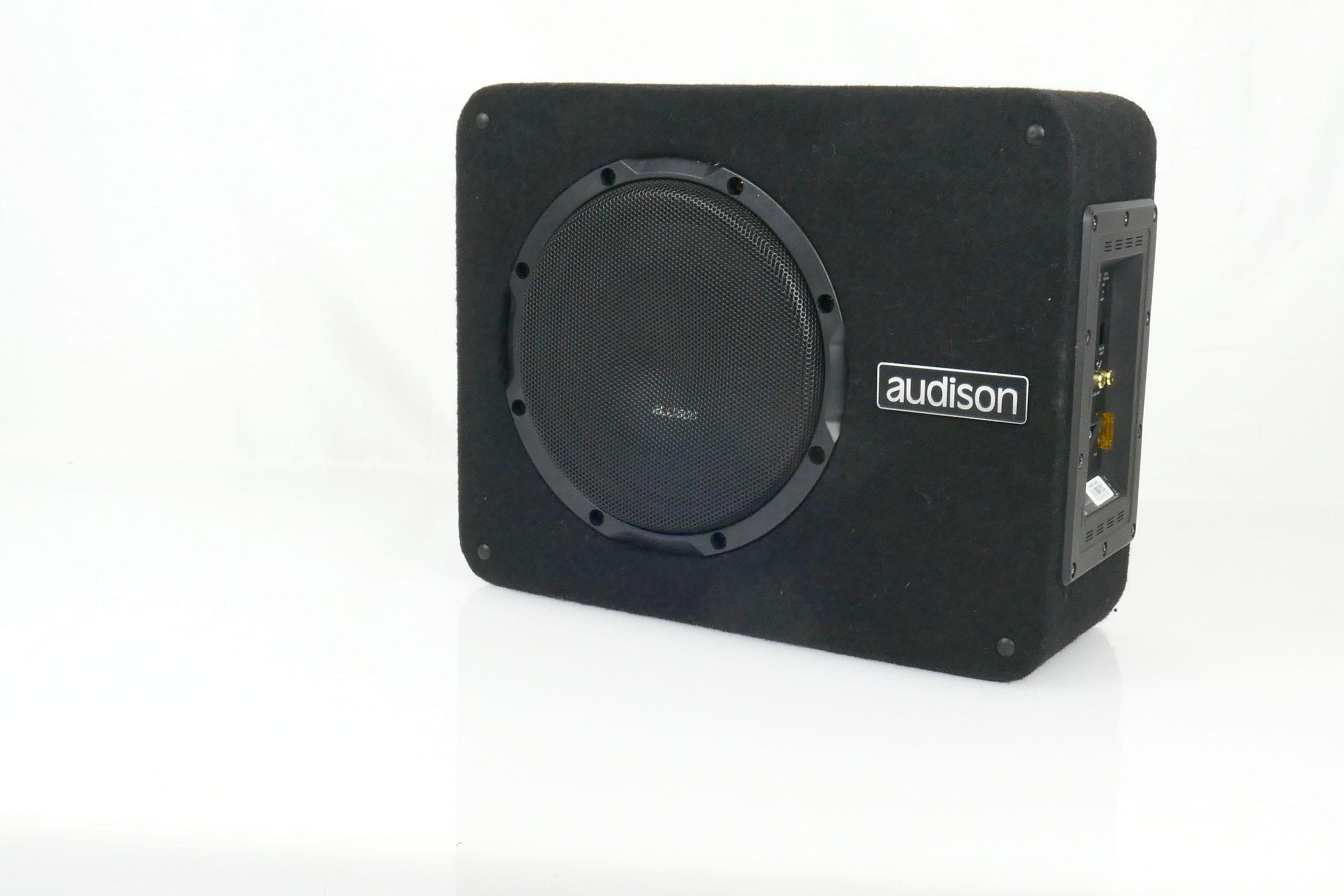
With today’s technology, it is possible to easily achieve bass reproduction that is felt in the chest area and extends to the lowest audible range with just an auxiliary bass speaker the size of a decent shoebox. An example of this is the Audison APBX 8 AS active subwoofer we tested for this review.
A lot in a small package
The bass unit, upholstered with black felt, measures 368 x 158 x 294 millimeters (height x width x depth), which makes it very compact. The enclosure houses an eight-inch element with a long, very rigid cone designed and manufactured by Audison, equipped with a dual speaker cone. The enclosure is closed in structure.
The amplification is provided by a specially designed Class D amplifier, which the manufacturer claims to deliver up to 250 watts of continuous power and 500 watts momentarily. Although the amplifier is small in size, such a high power is achieved thanks to the extremely good efficiency of a Class D amplifier and, in this case, Audison’s He-Li technology (High efficiency / Low impedance). The idea is to drive the amplifier with a very low load. The nominal impedance of the element is only 0.4 ohms (!), which would instantly put an ordinary amplifier to its knees. In this case, the amplifier is designed specifically to operate at very low loads. This allows for high power but with low power consumption. Of course, however, there is still enough current (max 15–20 amps) to power the power cable, so no bulky wire or bulky wiring from the headlights is needed.
Almost anywhere
Although it is very compact in size, the case nevertheless has enough space and especially height that it may not be able to fit under the front seat. The extra bass is intended to be installed primarily in the cargo area. However, the Audison case is so small that it easily fits into any corner of the trunk or even into the spare tire compartment or even under the fixed hat shelf.
For placement purposes, subbari offers two options. If you want the pitch to be as low as possible, you can point the element downwards. If you want more power and separation, you can point it upwards. Otherwise, the best placement for the subbar is best found by experimenting. It really is worth it.
Regardless of the type of subwoofer you are installing, it is advisable to purchase a subwoofer installation kit when installing it yourself. This kit usually includes a RCA cable, a wake-up current cable, a thick, at least eight square millimeter power cable for the battery to be plugged into, and a fuse box for the power cable so that if the power cable should accidentally come into contact with the chassis, no damage will occur.
Installing a completely new setup isn’t exactly a quick process, and you should definitely allow at least a few hours for that – especially if you want a clean finish.
First, you need to pull the power cord to the battery’s plus terminal. In the case of an active subwoofer, any wiring from cigarette lighter or taillight connections won’t be enough, because the amplifier consumes several tens of amps of power. The location of the wire entry in the trunk may be tricky and require partial removal of the dashboard. This is often the most laborious step of the project.
The red wire is connected to the positive terminal of the battery with a ring connector. It is also advisable to connect a fuse a few tens of centimeters from the battery. It is best to connect the power to the battery only at the final stage, when the installation is otherwise complete and the subwoofer can be put on the line. It is most convenient to connect the negative wire directly to the car chassis.
Active subwoofers often have both line-level RCA connections and speaker-level inputs. The options are therefore to capture the speaker-level audio signal from, for example, the rear speakers’ wires, or alternatively to capture the line-level signal directly from the player. At the same time, the player requires a trigger line that provides a wake-up signal to the subwoofer’s amplifier.
Many car manufacturers' own players do not have RCA and trigger power outputs, but this is often remedied by a separate vehicle-specific adapter cable, which is worth asking for at the store's checkout when purchasing other accessories at the same time.
For a neat installation, you often have to remove some of the car’s upholstery or trim panels, which allows you to hide the wires. You should bring along some duct tape and electrical tape for installation work. It’s a good idea to attach the subbar to the car’s structure in one way or another so that it won’t fly into the passengers’ necks in an accident or when braking suddenly. If you want to keep the subbar relatively easy to remove, you can attach it, for example, with cargo covers.
We placed the subbar’s cargo compartment in the right rear corner, with the element facing away from the side panel. The attachment was achieved using narrow tightening straps.








 Suomi
Suomi  English