We stare at the backlit screens more than ever before. With the triumph of interactive technology, thousands of small bulbs point directly into our eyes from morning until night. The display technology based on electrophotographic ink provides us with the same reading experience as the paper that has governed the market for smart devices for thousands of years, but at the same time takes advantage of many of the benefits of modern information processing. AVPlus investigated what e-ink is all about, where it is used, and what the future holds.
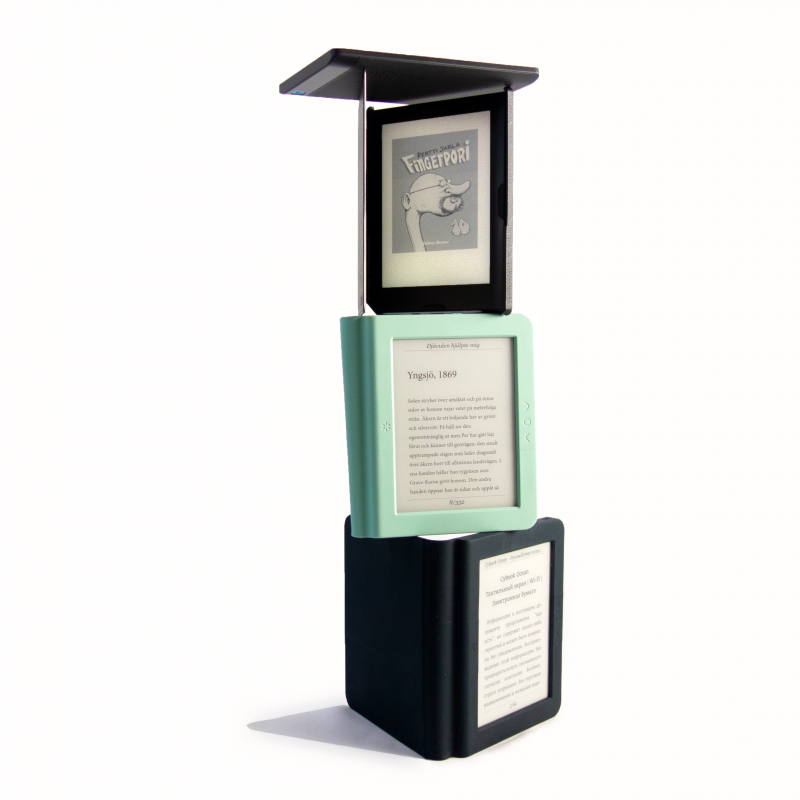
In the test: Kobo Aura Edition 2 / Bookeen Cybook Muse FrontLight / Bookeen Muse / Letto Frontlight 2
Text & images: Jemo Kettunen
Published in the AVPlus magazine 4/2018.
E-readers based on electro-ink have been making their way into the market for about a decade now. Many technically-savvy people remember the boom when Amazon’s Kindle broke sales records. E-readers that have gained some level of popularity worldwide seem to have remained in the shadows in Finland, with tablets and smartphones taking the lead. However, Ekirjo has still got its friends in Härmä, and operators like Elisan and Adlibriksen also distribute not only domestic e-books but also their reading devices.
Following the news of the competition between Kindle and Nook in previous years, I remember thinking that an e-reader was the last useless thing. Only when my French friend brought the popular electronic book reader to my attention did I realize the error of my prejudices. Although I had heard that a display without backlight would not strain the eyes, the device’s naturalness seemed miraculous. For my French friend, on the other hand, what interested her more were the library books that were stored in her device’s memory, and the fact that a passive e-ink device would not need to be charged even once during the entire visit.
Old-fashioned technology?
The technology based on electro-ink is not exactly a recent invention. Xerox made the first tests in this field as early as 1973. The current form of e-ink began to develop in the late 1990s, so it can be considered that it has survived not only childhood diseases but also the challenges of adolescence.
The electric charge traveling across the surface of the electronic paper moves a microscopic black ball between the bottom and top surfaces of the paper. This results in either a black or a white dot appearing on the screen. The electric charge is only consumed during the movement of the black ball, and after that the image can remain on the screen without any further command until entropy eventually disappears.
The display of an e-reader based on electro-ink is therefore passive and requires light for the reading experience, just as with ordinary paper. Therefore, a series of LEDs have been hidden under the edge of many current-generation e-readers. Unlike traditional backlit displays, this technology is called front-lit.
With the front light on, the display may at first glance resemble a black-and-white tablet. However, the user experience is significantly different from viewing the screen. If you think of the laptop’s screen as a wall of lights aimed directly at your eyes, the low light of the e-reader is directed not at your eyes but directly at the object you are looking at.
Frontlight is also a more economical backlight technology. The light associated with an electronic paper display is focused onto the reading area of the display, and it does not waste energy in the backlight like an OLED or LCD display. Along with frontlight, the battery life of an e-reader lasts much longer than that of ordinary smart devices.
Why isn’t this technology used, for example, on laptops, tablets or smartphones? In addition to the challenge posed by the power of the lighting, the display technology of the e-paper is so far relatively slow. The command of passive ink droplets still results in a slight latency. The delay is not so significant that it would be noticeable while reading a book, but it is large enough that playing Tetris on current devices is not a pleasant experience.
Modern readers in the experiment
The current generation e-reader has a front light as standard. In addition, most devices also have Wi-Fi and a touchscreen. Many manufacturers have models that are even waterproof. So, a beach holiday or a moment of luxury in the form of a foam bath is perfectly possible with the right model e-reader in your hand.
The software side has also evolved over the past decade. You can change the font, line spacing, and layout, add highlights and notes to the text, and many e-readers have an internal dictionary that you can consult directly by pointing to a strange word found in the text.
In Finland, e-readers from several leading manufacturers are available, and we tried a few of the most common ones.
Technical details and features
| Brand & model | Kobo Aura Edition 2 | Bookeen Cybook Muse FrontLight | Bookeen Muse | Letto Frontlight 2 |
|---|---|---|---|---|
| Price | 157,90 € | 109 € | 139 € | 129 € |
| Representative | Verkkokauppa.com | Elisa | Elisa | Adlibris |
| Additional information | kobo.com | bookeen.com | bookeen.com | adlibris.com |
| Display | 6” HD e-ink Carta | 6” e-ink Carta, dpi:213 | 6” e-ink, dpi: 213 | 6” e-ink, dpi: 213 |
| Front light | Yes | Yes | Yes | Yes |
| Battery | 1500 mAh | 1900 mAh | 1900 mAh | 1900 mAh |
| Battery life* | Up to 2 months | For weeks | 1 month | 1 month |
| Processor | Freescale 1 Ghz | Cortex A8, 1 Ghz | Allwinner A13 Cortex, 1 Ghz | Allwinner A13 Cortex, 1 Ghz |
| Connections | Wifi, micro USB | Wifi, micro USB | Wifi, micro USB | Wifi, micro USB |
| Memory | 4gt | 4gt + microSDHC | 8 GB | 8 GB |
| Operating system | Kobo Firmware | Linux | Linux/Adobe Reader Mobile | Linux/Adobe Reader Mobile |
| Supported book formats | EPUB, epub3, PDF, MOBI, TXT, HTML, RTF, CBZ, CBR | Adobe DRM, EPUB, PDF, HTML, TXT, FB2, DjVu | EPUB, PDF, Adobe DRM, HTML, TXT, FB2, DjVu | EPUB, PDF, Adobe DRM, HTML, TXT, FB2, DjVu |
| Dimensions | 159 x 113 x 8.5 mm | 116 x 155 x 8 mm | 134 x 155 x 15 mm | 134 x 155 x 15 mm |
| Weight | 174 g | 180 g | 320 g | 320 g |
| Other | Gyroscope for identifying the direction of movement | Gyroscope for identifying the direction of movement | ||
| During the test period, the battery did not run out on any of the devices. The battery life is as stated by the manufacturer. |
The design of the Kobo combines Canadian and Japanese design expertise.
Kobo Aura
Canadian Kobo (an anagram of the word book) is one of the leading manufacturers of e-readers, and the readers of its Aura series are listed among the best e-reader devices in the lists of AVPlussa as well. So it is no surprise that Aura also sparked positive reactions in the AVPlussa readership.
The soft-edged but streamlined design of the Aura is comfortable to hold, and its rounded rear provides a firm grip for the fingers holding the book. The reader is lightweight at 174 grams and doesn't weigh down the wrist.
The Auron user interface is intuitive. Many e-readers have small buttons on the screen for turning the page. The Auron has only a power button; otherwise, the device is controlled using the touchscreen.
Turning the page is done by swiping the screen. Pressing the center button opens a menu from which you can, among other things, change the book and go to the online bookstore. The menu also includes a statistics section that shows how much of the book you have read and how many hours of reading experience you still have left. It is possible to set a pause on a key page, which would be useful, for example, when reading course literature.
The calibration of the device’s touchscreen is a bit different from what the hand that is used to smartphones and tablets is used to. When typing, you had to press a slightly different spot than you would expect, but fortunately typing isn’t the device’s bread and butter.
It should be mentioned that Aurasta also has an online browser, but I cannot recommend browsing even the most graphically-rich pages from an e-paper.
The front light has a stepless adjustment, and of course you can also completely turn it off if you wish. At first, the device’s way of flashing the entire e-matrix display in black for about seven pages was somewhat confusing. However, this is a programmed feature to ensure the reliability of the display, preventing the appearance of ghost images during longer periods.
A reader in a relaxed state wakes up after pressing the power button in about a second and continues from where they left off. With a fully charged Aurora, the battery drained about a fifth in the two-week test period, even that. So the acclaimed battery life of e-readers is not just a ploy to attract advertisers.
The aspect that raised suspicion in Auran’s user experience was its apparent lack of protection. While folding front covers and pouches are available for the device, the usability of the inherently compact device was so pleasant that one wouldn’t want to make the device any heavier with third-party covers. The display screen, on the other hand, is slightly recessed below the device, so in home use the unprotected Auran can be placed on a tabletop without fear of scratching the screen.
Letto Frontlight 2 and Bookeen Cybook Saga – like two peas in a pod.
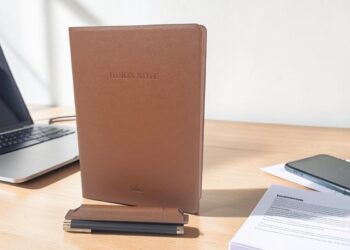
The mouse's leather protective case provides a good tactile feel even during longer sessions of typing.
Bookeen Cybook Muse Cybook
The Muse is very similar to the Aura from Kobo: a plastic shell and lightweight e-reader with a six-inch display, with adjustable front light and a functional touchpad.
Instead of the Canadian finesse of the Kobon, however, there remains a French twist. Or rather, the lack of it, as Bookeen has sought to add personality by cutting the bottom of the device to resemble a notch reminiscent of a mouse pad.
The mouse also has a touch screen, in addition to which there are two buttons on the edge of the screen that rotate the display. The buttons are on opposite sides, so the button that rotates the screen backwards feels more like a symmetrical addition.
At the bottom of the screen is a button that opens the main menu. The power button is located a bit awkwardly at the bottom of the device, which requires you to use your thumb to pry it out. The power button isn’t the most sensitive either, so you might have to waste another press to wake the device up.
A bit surprisingly, Muse turned out to be underpowered. It might have taken several seconds to start up, and the menu sometimes worked with a significant delay. Reading the comic in Muse was almost unbearable, as the page updates on Fingerporin took a full minute at worst. In the meantime, of course, one had already begun to suspect the usability of the flip button; pressing it again, well, you know the rest.
With ordinary text, there was no slowdown or neck strain. As I immersed myself in Mark Twain’s words, the experience was not interrupted, at least not by the hardware.
The Muse gets off to a slow start with its heavy workload and clunky buttons. As a basic reader, however, the device does its job. The plus point is also the aesthetically pleasing leather case that comes with the device, which not only provides a firm grip but also protects the device and its display from scratches on the bottom of the backpack.
Letto Frontlight 2
The Letto reader, marketed by Adlibriksen, is not only a good and sturdy e-book reader, but also surprisingly completely identical to the product sold by Elisa, Bookeen Saga. The difference between the devices that were tested was only the logo printed on the cardboard case. The manufacturer of Leto was revealed to be the French company Bookeen in the small print of the manual, so it is apparently just a product manufactured with different licenses, of which no functional differences were found in the testing environment.
Compared to its two lighter competitors, Letto differs primarily in its sheer mass. Letto isn’t quite as heavy as the Kobon, but it’s not much heavier either. The durability comes from the impact-resistant rubber protective case, which is equipped with a magnetic cover clip.
The intelligent front cover automatically puts the Leto into sleep mode when it is in place and starts it up again when it is opened. The cover also magnetically attaches to the back of the device, staying out of the way when it is not needed.
The functionalized shell is also the only problem with the Letto Frontlight 2. The thick rubber casing adds so much mass to the device that in the comfort comparison, the heavier Letto loses out to the lighter Kobol. On the other hand, the 320-gram weight of the Letto is not very significant when compared to a slightly thicker model, so in use the device is significantly more ergonomic than the book.
In addition to the touchscreen functionality, Letoa has three small buttons located on the right side of the screen that can be used to turn the page and open the device menu. There is also a button on the left side for the front light function.
A French engineer has come up with a good idea when investing in a device that allows the reader to change the orientation of the e-book. In other experiments with e-readers, the page is turned forward either by swiping the right side of the page or by pressing the button on the right side of the screen. In Leto, the forward and back buttons are always on the same side of the screen, so when turning the device upside down, the control point also moves to within reach of the left thumb. Tyranny of the lower right hand!
Overall, the Letto Frontlight 2 / Cybook Saga left a strong and high-quality impression. It is a sturdy reading device that will surely last for years of heavy use.
The library is easy to navigate
Adding a book to an e-reader is, in its simplest form, really easy. The device has access to the bookstore app via Wi-Fi, where the desired opus is transferred to the shopping cart with a tap. The operation can also be accomplished by transferring the book's contents in a classic way via a USB connection from the computer to the reader's memory.
Future material
Alongside e-readers, e-paper has not yet achieved full-scale commercial success. If we are to believe the prognosticators, the situation will change in the coming years. Electricity-saving e-paper, blessed with virtually zero power consumption, is well suited for, for example, price information in shops, posters, and notice boards.
There are also major technological breakthroughs on the horizon. The CLEARink company has promised to bring to market an electrophoretic display with over 4,000 colors this year, which is also capable of reproducing real-time moving images. The company’s prototype was awarded the Best Display of the Year at the 2017 Display Week exhibition.
Electronic paper also doesn’t necessarily need a heavy frame around it. There are cost-effective electronic paper displays that are thin, flexible, and rechargeable again and again. The technology is also very cheap to implement, and the sizes of the sheets are on the rise. Thus, for example, newspapers could very well arrive in the near future in a disposable electronic paper format.
Summary
More to read!
Publishing a book electronically is of course more cost-effective than starting a printing press, and new domestic literature can also be found in electronic format in practice. For example, Elisa and AdLibris offer extensive selections of new e-literature in the Finnish language, and an electronic book is often more affordable than a printed copy.
The most popular foreign online bookshops are, of course, the industry market leader Amazon. However, what is noteworthy about Amazon’s online bookstore is the company’s own Kindle format, which other manufacturers’ devices do not generally support.
Kindle readers are available for Android-based devices, and third parties have enabled conversion between different electronic formats. The ePub format has become a de facto standard in the industry; practically all readers, including Kindle ones, understand it. PDF and the most common text formats are also supported by most reading devices.
In addition to the electronic bookshop, a public lending service is also available for e-books. Libraries currently offer temporary lending of e-books that can be downloaded to a reading device, but which are subject to the same time-limited restriction as physical books under the lending license. After the loan period ends, the book ceases to function or disappears.
For those who are hooked on e-books, there is indeed a free lunch too. For the classic novel lover, Project Gutenberg is a worthwhile destination, offering tens of thousands of e-books on its website whose copyrights have expired. Kafka, Arthur Conan Doyle, Poe, Jung, Wilde and Machiavelli; the canon of Western literature awaits the bibliophile equipped with an e-reader just a click away.