Sentimentality does not belong in the vocabulary of this speaker. The slimline Triton Reference takes the room by storm.
Text: Mats Meyer-Lie Photos: Manufacturer, Hifi & Musik
Published in the AVPlus magazine 4/2018.
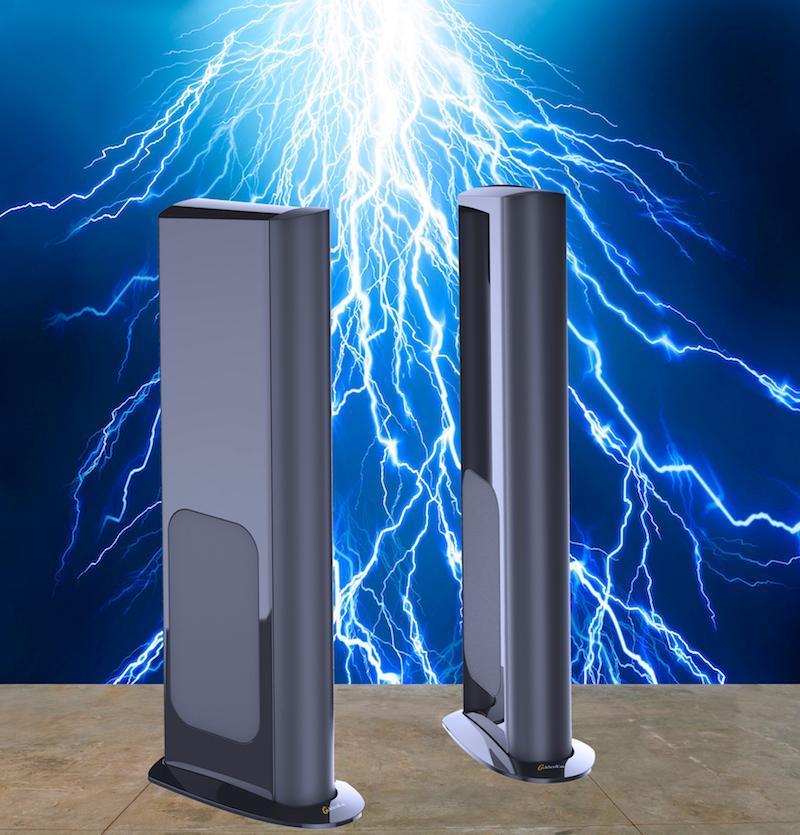
Did lightning strike just now? It may sound like an exaggeration, but that’s exactly what it felt like when the GoldenEar Triton Reference speakers, in their black and midnight color scheme, roared so loudly that the walls shook. This is not surprising, since these are massive speakers. However, viewed from the front, they appear so narrow and unassuming that it’s impossible to realize how insanely loud pressure waves the speakers are capable of producing.
The sound has a true-size physical dimensions and is equipped with a bass sound that puts the listener’s breath in their throat. If you’re looking for deep and low bass, then here are giants with bass reserves that are far beyond compare. All talk about the need for a subwoofer can be forgotten immediately!
The secret of the speakers lies in the element configuration. The frequencies below 100 Hertz are reproduced by three forward-facing oval bass speakers. They are powered by 1.8-kilowatt Class-D amplifiers. And that’s not all. At the lower end of the bass frequency range, a four-speaker passive radiator is connected to the bass line. The response drops down to the very bottom.
Thanks to careful coordination, the advantage of this type of solution is that the small movement energy in the active elements creates a large movement path in the passive bass radiators. Additionally, these are positioned to reinforce the bass near the floor. This solution also ensures a more even acoustic connection with the room. The idea of active or passive bass elements mounted on the sides of the speaker is an old one. It aims to keep the front panel of the speaker narrow to minimize disturbing resonances while providing more mounting area for the robust bass elements.
Sandy Gross, founder of GoldenEar, knows this technology better than most others. Already in the 1970s and 1980s, he was involved in designing passive speaker systems for Polk, but especially for Definitive Technology, which he was also involved in founding. It is no wonder that the bass technology of GoldenEar’s speakers and the use of passive speakers in a high and narrow enclosure resemble similar solutions in some Definitive Technology speaker models – with the crucial difference that Sandy Gross has moved away from bipolar technology (the elements are both front- and rear-facing) and no longer uses dome elements for reproducing bass frequencies.
The T-Refin (the flagship model's nickname) large, enclosed enclosure and its brutal bass potential have required not only proper bracing and damping, but also a design that avoids parallel walls to prevent the internal standing waves from interfering.
With a new 6-inch mid-range driver, a new phase plug, and a more efficient magnetic design than previous models.
Although the T-Ref naturally attracts attention with its bass performance, the speaker’s sound isn’t just raw, with the bass power roaring out of the woofers. Above 100 Hz, there’s a mid-range/bass treble section. The treble element is mounted slightly above the center of the two wide-band six-inch drivers. The HVFR treble element is an improved version (half the size of the magnet) of the AMT (Air Motion Transformer) horn treble element used in GoldenEar’s flagship models – or a variant of it.
It is a kind of ribbon loudspeaker where the folded film moves like a ribbon, transferring the air pressure in a straight angle relative to the film surface. The solution is expensive but effective because the film only needs to move a fraction of what is required for, for example, a cup-shaped dome loudspeaker to achieve the same sound pressure. The advantages, such as high resolution, low distortion, high power efficiency, and at least on paper the absence of cone-shaped non-linearity, combined with new materials and manufacturing methods, have made this technology increasingly popular among loudspeaker manufacturers, if not even trendsetting.
In the Triton Reference case, the D’Appolito-type treble and midrange elements are positioned in a surprisingly harmonious way. The elements provide a very wide and homogeneous sound radiation in the horizontal direction, but also a significantly wider reproduction angle in the vertical direction. In addition, the ribbon tweeter gives the speaker a pleasant rounded character. At the same time, it does, however, sacrifice some of the clarity and brightness in the higher frequencies, which is further emphasized by the powerful low-end register. What remains dominant in the sound of this speaker is its bass foundation and the ability to make the room’s atmosphere a living performance space.
The sound certainly includes a lot of detail, and the stereo image is also clear, but the biggest impact was made by the raw sense of power and the illusion of instruments striving out of the speakers, instruments that can be touched with the hands. In this price range, you rarely hear a speaker that can reproduce the instruments and the singers in such a physically concrete way. The essence of Triton’s sound and approach lies in its overall approach to music. Despite the sharpness and nuance of the sound, the Triton Reference can be considered a soft-tempered speaker that gently sweeps aside the less valuable elements with its large, dramatic brushstrokes. And if you so wish, even with unhealthy levels of loudness that do not dampen the speaker in any way.
The GoldenEar Tritonia should not be aimed towards the listening position, as measured directly from the front, the response (green) has a significant rise in the upper treble. However, measured from 60 degrees from the side (red), the treble response flattens considerably. The blue curve shows what happens when the active bass is turned off.
SUMMARY
Forget the subwoofer, enjoy the bass
Triton costs quite a lot of money, but keep in mind that a subwoofer is really not necessary with this speaker. The Triton can also be driven by a simple small amplifier, which hardly ever happens when the listener starts to understand the inherent treble characteristics of these speakers. It’s the perfect speaker for someone who wants the best of high-fidelity audio but with a focus on loudness and bass.
+ (Lower) bass
+ Sound pressure output capability
+ Experientialism
– Lack of final detail
GoldenEar Triton Reference
Price: 9,990 €
Representative: Musiikin.com
(www.musiikin.com)
Additional information: www.goldenear.com
Operating principle: 3-way speaker with active bass amplification
High-frequency treble: HVFR waveguide treble
Middle voice: Two 6”
Bass: Three 6x10” + four 6x10”
9.5x10.25” passive emitter
Sampling frequencies: 100 Hz, 3.5 kHz
Bass amplifier: 1.8 kW, class d, dsp amplifier
Nominal impedance: 8 Ohm
Sensitivity: 93 dB
Dimensions (l x w x h): 23 x 147 x 47 cm
Weight: 49 kg