The Danish company Jamo has taken a new approach to the 2.1 system. It downsized its high-end R909 dipole speakers and added a subwoofer. We tested how the system sounds.
Generally speaking, 2.1 systems don’t inspire much enthusiasm. They often fall somewhere between a proper, multi-channel home theater system and computer speakers. However, you can look at it from another angle—as a high-quality pair of stereo speakers whose bass reproduction is simply handled by an external subwoofer.
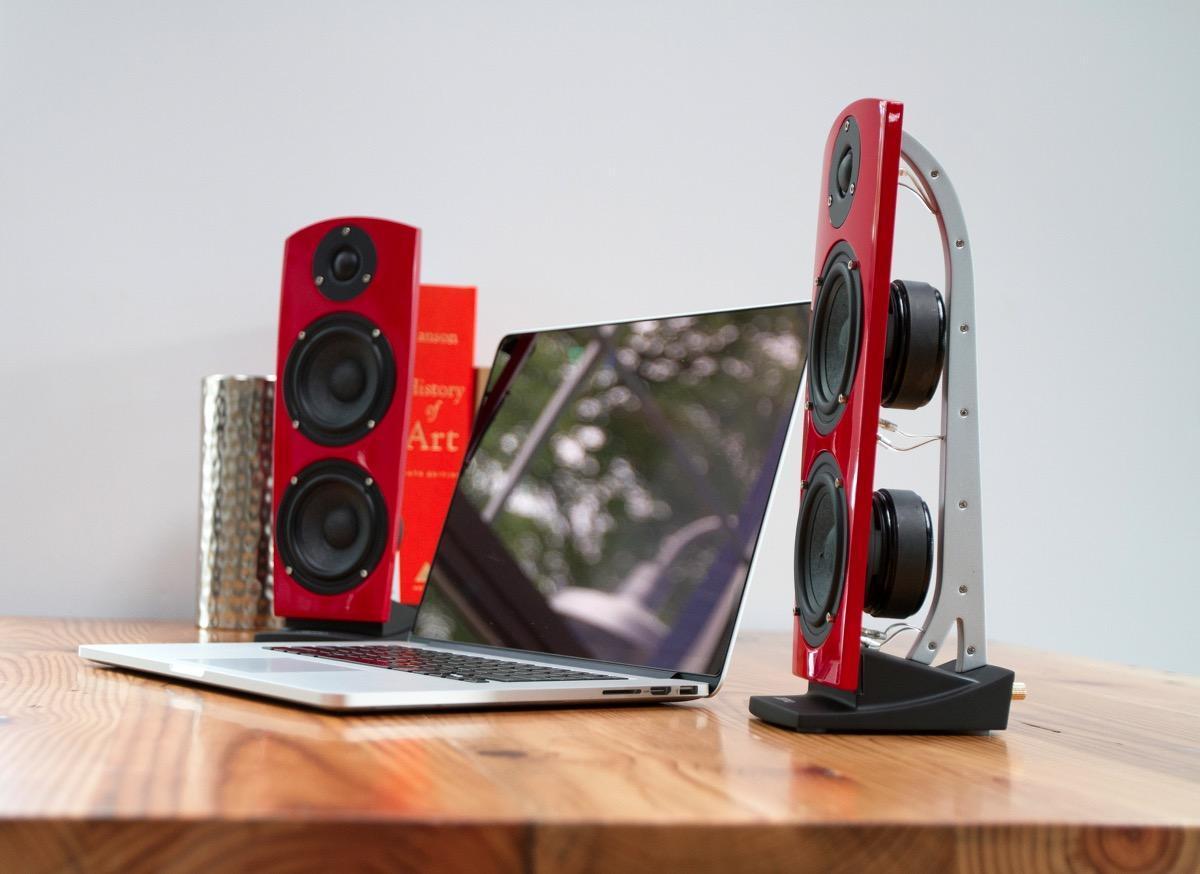
This is likely what the Danish manufacturer Jamo had in mind when designing the DS7 system. Its satellite speakers are essentially miniature versions of Jamo’s R909 high-end speakers, which are ten times more expensive and four times larger. Like their larger counterparts, the satellite speakers are dipole speakers, which is a rare design in consumer-grade speakers. However, unlike their larger counterparts, the bass reproduction is achieved using a reflex enclosure.
Jamo has also focused on design in the DS7 speakers we tested. Even though sound quality is ultimately what matters, you don’t really want to put just any old-looking speakers in your living room or even on your computer desk. That’s what makes this series so appealing.
First Impressions and Implementation
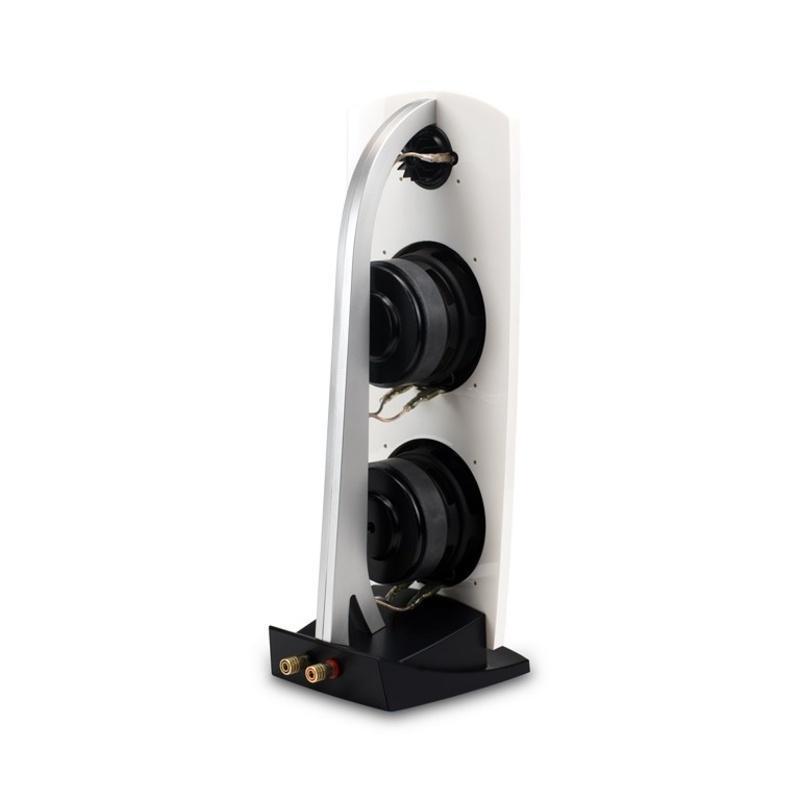
To begin with, it might be helpful to say a few words about dipole speakers. Unlike traditional box-type speakers, they do not have an actual enclosure. The speaker drivers are simply mounted on the front panel, and the back is open.
Of course, this is a matter of personal taste, but there’s something visually appealing about the Jamo DS7’s airy-looking design. The set is available in white, red, or black. In practice, only the color of the satellite speakers changes; the subwoofer always remains black.
The satellite speakers have 87-millimeter mid-bass drivers and 20-millimeter tweeters.
The connectors, which are secured with terminal screws, are located on the speaker stand. The wires connecting the terminal screws to the drivers are visible at the back. You should therefore avoid placing the speaker within reach of small children or pets that like to chew on things.
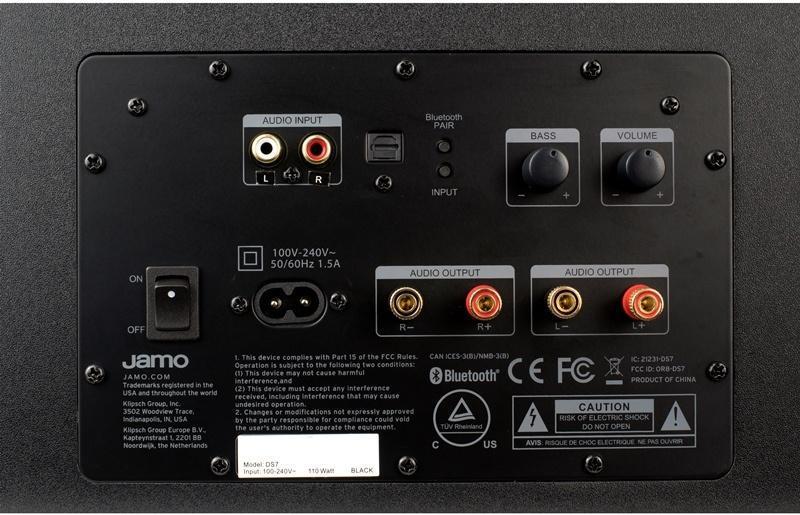
The subwoofer features a bass-reflex enclosure with a rear-firing port and an 8-inch driver facing to the side. The back of the cabinet features a good selection of audio input connections, including one analog RCA input, one optical input, and Bluetooth for wireless playback sources. These allow you to connect, for example, a TV, a player with analog outputs, and a mobile device to the system simultaneously.
In addition to the input connectors, the subwoofer’s rear panel features Bluetooth pairing buttons, bass and volume controls, and connectors for a pair of speakers. The satellite speakers are passive, and the amplifier built into the subwoofer handles their amplification as well.
Sound
When watching movies, the sound feels very realistic. The satellite speakers seem to fill the room better than the enclosed-cabinet models. It would be interesting to try a surround sound system built with similar components.
Even when it comes to listening to music, these speakers perform better than average compared to other satellite speakers in the same price range. While they certainly can’t replace true hi-fi speakers, their sound is airy and full-bodied. The bass blends comfortably into the overall sound and doesn’t dominate the soundstage even at full volume. The treble is reproduced quite neutrally. It has a bit of edge to it, but not in a strident way.
In the lowest midrange and highest bass frequencies, the speakers aren't at their best when compared to two reasonably sized box speakers. With a heavily mixed, heavy-hitting track, the sound can easily get a bit muddy, but it handles airier mixes admirably.
A Sense of Style and Class
The Jamo DS7 speakers are the choice for design enthusiasts, and they also offer good sound quality for their price range. As companions for a TV—and especially a computer—they perform better than average. They’re versatile, yet the set doesn’t take up much space.
The dipole speakers create a natural sense of space that doesn’t sound too exotic to ears accustomed to cabinet speakers. Here’s a tip for TV manufacturers: put some dipoles on either side of the screen and throw in a subwoofer to round out the package. It works!
What are dipole speakers?
Dipole speakers are slightly more demanding in terms of placement than traditional speakers. This is because the sound waves coming from behind the dipoles are out of phase with those coming from the front, so if they’re positioned poorly, they can cancel each other out in an undesirable way. On the other hand, for the same reason, there are hardly any sound waves on the sides of the speaker, so these speakers are more directional than typical box speakers.
Placing the bass driver in a separate subwoofer enclosure is a smart solution for speakers the size of the DS7, which are designed for desktops or TV stands, since bass reproduction is particularly difficult to achieve in dipole speakers. If the designers had wanted the satellite speakers to produce deep bass, the front baffle would have had to be very wide to prevent phase issues.
JAMO DS7
Price: 549 €
Further information: www.loudgroup.fi & www.jamo.com
Power: 160 watts
Frequency range: 20 – 20,000 Hz
Satellite speakers: 2 x 3.4-inch midrange drivers, 1 x 1-inch tweeter
Subwoofer: 8-inch driver
Bluetooth 4.0
Connections: 1 x optical, 1 x 3.5 mm, 1 x speaker output
Speaker dimensions (W x H x D): 101.6 x 381 x 304.8 mm
Weight of speakers: 1.7 kg per speaker
Subwoofer dimensions (W x H x D): 254 x 381 x 304.8 mm
Subwoofer weight: 7.9 kg
Colors: Black, white, red
Subwoofer color: Black
This article is a summary of an experiment published in the 3/2017 issue of AVPlus.
TEXT: Joni Nikkola PHOTOS: Manufacturer