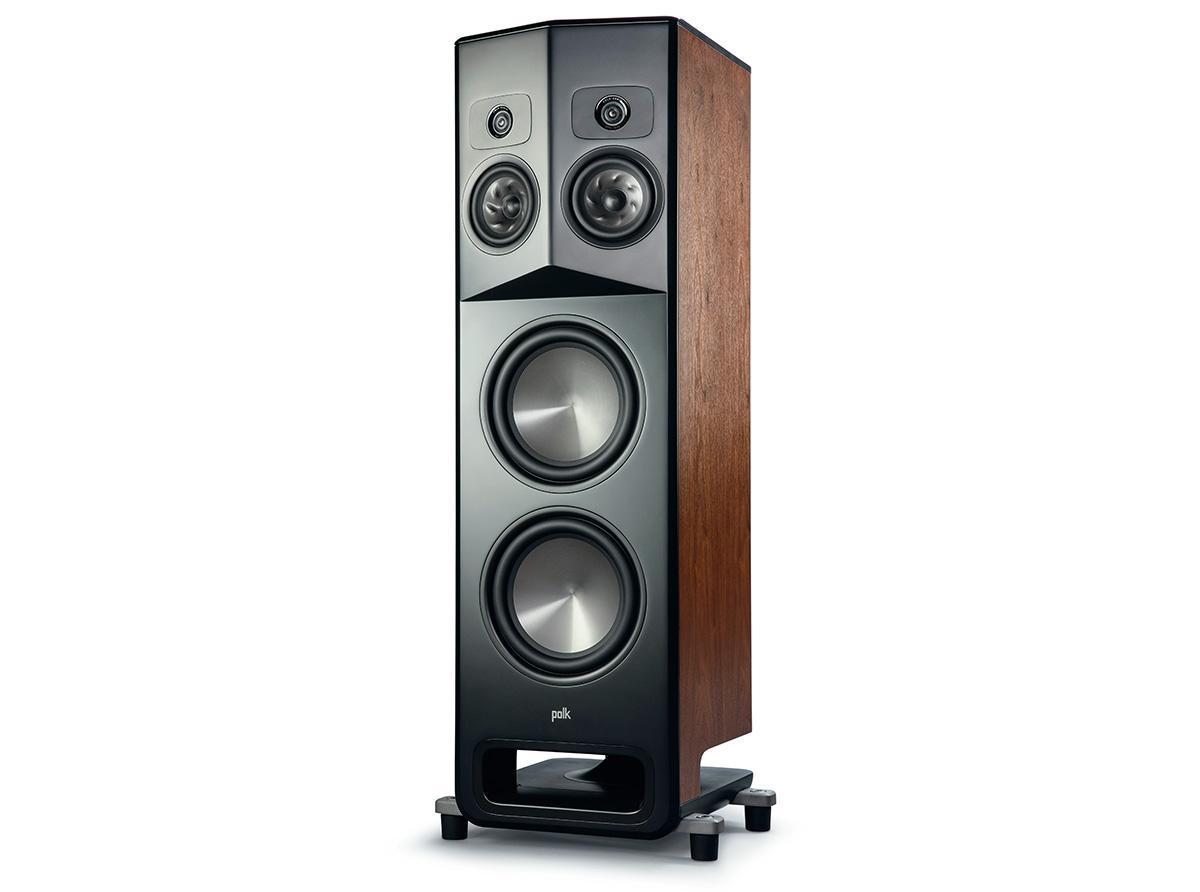
The legendary American loudspeaker manufacturer Polk Audio is making its mark in Europe with the new Legend series loudspeakers. The largest and most technologically advanced of these is the L800.
Text: Jonas Bryngelsson & the AVPlus editorial team
Photos: Sound United
Measurements: Hifi&Musik
When a new young speaker manufacturer enters the market, it often does so by introducing a new or newly interpreted technology it has developed. For some manufacturers, this original technology – more or less improved – remains unchanged from decade to decade. For others, the use of the old technology declines and new technology is introduced in its place. Then there are those speaker manufacturers who have abandoned their early technology but revive it after a long hiatus. Polk Audio, founded in 1972, belongs to the latter group.
In the case of Polkin, the technology is called SDA. The abbreviation comes from The words Stereo Dimensional Array. This technology designed to prevent crosstalk between channels was used immediately in the second speaker of the company, the Monitor 10, and from 1976 onwards, continuously until 1997. After that, Polk has used SDA technology only in its better head-worn soundbar but not in ordinary home stereo speakers, before bringing the SDA technology back to the market with the Legend series in the fall of last year. SDA made a comeback with the flagship model of the series, the Legend 800.
The impetus for developing SDA technology came from Polkin founder Matthew Polk's first encounter with European loudspeakers in the late 1960s. He noticed that they sounded cleaner and more refined in the mid-range and treble, but above all they were superior in sound quality. This led to the idea of combining the powerful bass response, dynamics, and high sound pressure output of American loudspeakers with the virtues of European loudspeakers: purity and imaging, spatial reproduction. SDA was the answer to this last challenge in particular.
The main point of the method is to get rid of cross-talk in the ears. In the phenomenon, it is about two stereo speakers leaking the sound of the left speaker to the right ear and vice versa with a delay. In the ideal situation envisioned by Alan Blumlein in the 1930s, the stereo effect occurs in such a way that the sounds recorded in the right channel reach the ear only from the right channel speaker and the left one only from the left one – as in headphones.
In Polk's first SDA speakers, the technology was implemented by adding one additional bass-oriented speaker to the speakers, which reproduced the sound of the speaker in the opposite channel (selected band) in the opposite phase. The distance between the two horizontally positioned stereo and SDA elements was approximately the same as the distance between a human ear. Thus, the direct stereo sound from the left speaker was interchanged with the indirect sound from the right speaker's SDA element before it reached the right ear! And vice versa. When no crosstalk occurs, the spatial sound at least potentially improves, the sound image expands beyond the speakers, and the separation between the channels becomes more precise. A true stereo experience, then!
Now, after more than 20 years of absence, SDA has been approved to participate in the Legend series’ flagship L800 model. According to Polkin, the L800 is its best loudspeaker ever. In a review for those familiar with the brand’s old SDA loudspeakers, there is undoubtedly some marketing hype involved, but the truth is that this is a very impressive and technically impressive loudspeaker.
The L800 is 25 percent narrower than Polk's early SDA speakers due to the more advanced SDA Pro version of the SDA technology. The SDA Pro speaker has a two-part control panel with angled edges at 15 degrees. This way, the speaker is already at the right angle to the listening position, and it doesn't need to be rotated 20 degrees to the center – to create a better and more accurate stereo effect – like Polk's first-generation SDA speakers.
In addition, the SDA Pro equalizer blocks unwanted overtones to the wrong ear across a wider, carefully selected band, and takes into account the effect of the so-called main umbrella effect on sound quality.
Technical and neat
The L800 is a powerful three-way speaker featuring a one-inch horn called the Pinnacle. According to Polkin, the completely redesigned element is self-developed, but it does resemble ScanSpeak’s similar models. The element has a curved cone. The rear chamber dampens the rear radiation. For the mid-range frequencies, the 5.25-inch element is housed in a closed housing. With the turbine geometry of the synthetic cone, Polkin has achieved the ideal relationship between cone stiffness and damping characteristics.






 Suomi
Suomi  English