Specialist magazine for entertainment electronics and new technology
  • Login
  • Register
Cart / 0,00 €

No products in the cart.

AVPlus
  • News
  • Tests & Comparisons
  • Presentations & Experiments
  • Articles & Guides
  • AVPlus Extra
  • Journal archive
No Result
View All Result
AVPlus
No Result
View All Result
in Experiment, Audio & Hifi, DA converters, Selection of delivery

With Mytek Liberty DAC in the experiment – professional-level conversion

Joni NikkolabyJoni Nikkola
18.11.2018
With Mytek Liberty DAC in the experiment – professional-level conversion
Reading Time: 11 mins read
A A

The domestic company Sound Factor recently added Mytek’s DA converters and other devices to its lineup. They have garnered so many positive reviews worldwide that we decided to immediately try the most affordable model in the lineup, the Liberty DAC.

Text: Joni Nikkola / Photos: AVPlus editorial team
The article was published in the AVPlus issue 5/2018

We listen to our music today almost exclusively in digital format, such as files or CDs. The exception is the analog purists who rely solely on vinyls or cassettes, which are probably relatively rare in proportion.

As with all audio reproduction, digital devices also play a big role. If the sound quality still sounds good even after buying high-quality speakers and a power amplifier, a decent DAC can make a surprisingly big difference. It converts the digital audio signal into an analog format that can be understood by, for example, speakers or headphones.

Such a device is built into not only hi-fi products like CD players or network players, but also more everyday devices like computers and smartphones – at least if they have an analog output connection. Often, this circuit hidden inside the casing of these devices goes unnoticed. However, a low-quality digital-to-analog converter can often be a bottleneck in the signal path, preventing other equipment from delivering honey to our ears.

Although, for example, a thousand-euro amplifier usually already has a reasonably high-quality DAC, it certainly doesn’t have a thousand-euro DAC. We tested one of them.

front panel e1542560315818

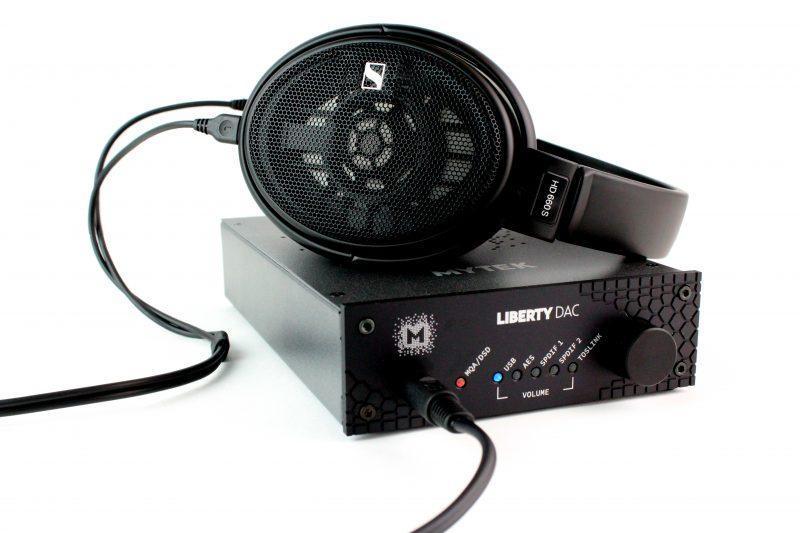
The simplified front panel features informative LEDs, a headphone jack, and a volume control wheel that doubles as a power button and playback source selector.

What is Mytek?

Mytekin devices have not been available in Finland before this summer. This is a US-based company founded in 1992 that manufactures audio equipment for high-end and professional use.

For the first few decades, Mytek focused on studio equipment designed for audio professionals, but in 2011 it expanded its product range to include hi-fi products. Consumer products include DA converters, amplifiers, and headphones amplifiers. For professionals, in addition to these, there are, for example, AD converters, clock radios, and converters. The company’s headquarters is located in New York, but the products are manufactured near Warsaw, Poland.

We took Liberty DACs from the selection to try them out; they are a slightly more compact, one-third narrower, and half the price version of the company’s previous models Brooklyn DACs and the more recent Brooklyn+ DACs. These models belong to both the hi-fi and studio models. Manhattan, on the other hand, is the flagship model of the manufacturer’s consumer-oriented DA converters.

In practice, the Liberty we tested combines the Brooklyn model’s ESS9018K2M circuit with the Brooklyn+ model’s performance. This makes the Liberty quite interesting as well, since while the Brooklyn+ DAC costs 2,195 euros, the Liberty costs 995 euros. That’s not exactly a small price, but still more affordable for the average consumer.

For some reason, the compromise has been abandoned. In addition to the size, the most noticeable changes to the Brooklynes are the change in the display to a row of LED lights and the narrower size. The Liberty also lacks an analog input and a phono input for the vinyl player. Volume control is only digital on the Brooklynes, while the analog option is available on the Liberty. The headphone output is unbalanced. The Liberty lacks an external speaker connection, which may be a stumbling point for many audio professionals. The remote control is also missing, and for those interested in tweaking, the Liberty lacks selectable presets. So there are differences, but many of them are not necessary for home use. Let’s examine whether the result is a meager compromise.

back panel e1542560888694

The compact rear panel reveals versatile digital input options. The analog outputs are balanced and unbalanced. An interesting detail of the device is that in addition to the AC connector, there is also a 12-volt connection for a separate transformer.

A solid act

The first thing that catches your eye about the Liberty DAC is that it feels sturdy. The case is metal, and the front panel is also sturdy to the touch. There are M-shaped cooling vents on the top of the device, which is a trademark of the manufacturer. In terms of its dimensions, the Liberty DAC fits comfortably in luggage, although it isn’t exactly mobile-friendly.

The device is so cleverly packaged that it takes about a minute to unpack, connect the power cables and place it on the table. The user manual is a fairly large document printed in large font, so you don’t need to keep it right next to your nose during the installation process. However, navigating the manual requires a certain level of English proficiency.

The front panel has a headphone jack and a row of LED indicators. The first one indicates whether the pcm, dsd, or mqa file is being played, and even indicates a different color if the mqa file is approved by the artist or producer. The same light indicates whether the device is in standby mode. The remaining LED indicators indicate which playback source is in use at any given time. Next to the lights is a volume control that can also be used to select the playback source. It serves as a volume control in addition to the power button.

The rear panel features a connection for a 240-volt power cord as well as a 12-volt power source or battery. According to the manufacturer, it is possible to achieve further improvement by purchasing the device’s internal 30-watt power supply and a more powerful external power source, preferably 5–10 times more efficient.

All inputs are digital. The best bit depth and resolution are achieved with the USB interface, which supports playback in PCM format with a maximum of 32 bits and 384 kilohertz quality, and DSD playback with a 256-fold quality. The coaxial interfaces, optical interface, and AES/EBU can handle 24 bits and 192 kilohertz respectively. They use DoP DSD with 64-fold quality. The manufacturer states that the dynamic range is 127 decibels.

Mytek Liberty also supports MQA streaming, which is used in, for example, the highest-quality Masters-level material on the Tidal streaming service. Additionally, the device supports the Roon software, which allows you to control multiple digital audio sources and search for songs from your own online storage and streaming services in a more versatile way.

Mytek Screenshot e1542559089736

With the Mytekin management app, you can, among other things, update the device software, select the input and change the LED colors. However, basic operation works without the app as well.

Software

The Mytek website also offers a driver and the Mytek Control Panel control software for Windows and macOS. For Windows computers, it is recommended to first install the USB 2.0 driver found on the Mytek website, as the installation of the software itself should be much easier. The Mac computer recognizes the device without the need for a separate USB 2.0 driver installation.

The Mytek Control Panel program allows you to check the device software version and, if necessary, update it. The update does not run completely automatically through the program; the update file must be downloaded manually through the browser and then opened in the application.

The same app is used with other Mytek current model DA converters, but the features at the bottom vary depending on the model. In practice, the features needed for listening are handled more conveniently from the device’s front panel, so the app is mostly needed for updating and rarely for fiddling with the settings.

Operation is straightforward thanks to the device’s simple user interface. If you use the converter, for example, as a companion on your desktop computer, it is still within reach. In that case, the lack of a remote control is not a problem. If, however, you plan to use the device, for example, in conjunction with stereo speakers, then changing the playback source, say from a television to a CD player, is a bit more cumbersome.

Estradi belongs to music

Do you know that sound engineer who has already done the groundwork expertly, who does the job with professionalism and knows what works and what matters? He knows that the best sound comes when the sound is perfect and the rhythm group plays in perfect unison. Well, maybe you don’t know that. In the same way as a professional sound engineer, the task of the da converter is not to add anything to the sound or to wave around the stage to get everyone excited. It only clears the way for good sound and makes the band and the audience have fun behind the scenes. Maybe a random rock policeman gives a thumbs-up and the band taps their backs after the gig.

That's how the Liberty DAC works too. The playback is effortless to hear, and it's not disturbed by the noise from the device itself, such as hums or distortion. The silence in the quiet sections is downright mesmerizing.

Sometimes the harshness and power typical of digital devices in the treble range are not noticeable. The upper register is delivered with enjoyable precision and clarity, but still with plenty of airiness in the treble. There is also plenty of airiness in the treble side.

There are no special sweet spots to be found in the midrange; as such, it shouldn’t be missed. It repeats effortlessly, dynamically, and in detail, and in even busier material it never runs out of space. The sound image is wide, deep, and airy. Massive Attack’s Angel, which is commonly used as a benchmark for bass reproduction, rarely, if ever, sounds as cleanly, controlled, and effortless as it does here.

We also briefly compared the device to the semi-professional Focusrite Saffire Pro 24 audio card, which costs about 300 euros. Compared to it, the dynamics are more refined, the bass is cleaner and more accurate, and the overall reproduction is cleaner and less cluttered. However, the most significant difference is in the resolution and clarity of the upper register. Compared to the M-Series, Focusrite gives the impression of being smaller in every respect.

It’s also great that even with inexpensive headphones, you can notice a significant difference in the sound in a better direction.

SUMMARY

Extremely good sound quality easily

Although Mytek Liberty is a compromise on principle, it doesn’t feel or sound like one. Nothing stands in the way of good sound – not to mention usability or audio performance shortcomings. If the Brooklyn+ DAC, with its strict rules, is the à la carte menu at a Michelin restaurant, Liberty is the dish recommended by the same kitchen. You can trust it to be good, even if the location of the chicken parm and the sauce spatter on the plate doesn’t seem to matter. And many prefer to trust the chef’s professionalism.

The home entertainment center from Liberty may not be lacking a remote control and analog inputs due to the lack of them. A home that relies entirely on digital audio does not need analog connections, and they are not a standard feature in a DAC. Overall, the Liberty DAC is a convincing addition to the audio market in terms of sound quality.

+ Intuitive and easy to use
+ Robust structure
+ Excellent sound quality
– Lack of remote control
– No analog inputs


Mytek Liberty DAC

Price: 995 €
Representative: Sound Factor (www.soundfactor.fi)
Further information: www.mytekdigital.com
Working principle: DA converter/headphone amplifier
Digital inputs: USB2, aes/ebu, 2 x coaxial, 2 x optical
Analog inputs: Unbalanced RCA, Balanced TRS, headphone output
Jitter: 10 ps
Headphone amplifier: 300 mA, 3 W, Impedance: 0.1 Ohm
Remote control: No
Weight: 1.5 kg
Dimensions: 140 mm x 216 mm x 44 mm

Bit depth and sampling frequency

The performance of da converters that play PCM files is usually reported in bit depth and sample rate. For example, the Liberty DAC is able to play PCM audio at 32-bit depth and 384 kHz sample rate via its USB connection. What does that mean?

Bit depth describes how many parts of the analog signal are sliced horizontally, i.e., along the amplitude axis. The more bits are used, the more precisely and subtly it is possible to interpret the extent of dynamics and the differences in sound volume.

The sampling frequency, in turn, tells how many parts of the audio signal are sampled on the time axis. In other words, it tells how many times the audio signal is sampled in one second. Therefore, for example, with a sampling frequency of 384 kilohertz, the sample is taken 384 thousand times per second.


PCM, DSD and MQA – what do the different digital audio formats mean?

PCM: By far the most common audio format is pcm, which stands for ”pulse code modulation”. The sound quality of a pcm file is indicated by the bit depth and the sample rate. The bit depth practically indicates the largest dynamic range of the file. For example, a cd-quality file, i.e. a 16-bit file, is able to specify the signal level with an accuracy of 65,536 steps. The sample rate, on the other hand, indicates how often a sound signal is sampled, i.e. sampled. In a cd-quality sound, the sample rate is 44,100 Hertz, meaning that a sample is taken as many times per second. This is slightly more than double the normal human hearing range.

DSD: Another way to record digital audio is dsd, or ”direct stream digital”, which was developed in the mid-1990s for SACD players designed to be successors to CD players. It works on a slightly different principle, as its bit depth is only 1. Data therefore only tells whether the level is lower (0) or higher (1) than the previous sample. Its sampling frequency is significantly higher, as the basic format, the so-called dsd64 file, has a sampling frequency of 2.8 megahertz. That is 64 times more than in CD audio. Since then, dsd128, dsd256 and dsd512 have also become available. The availability of dsd-format material is significantly more difficult to achieve than PCM. Dsd is generally considered to be ”more analog” than PCM, but its drawbacks include higher noise levels and more difficult handling. Dsd can be transferred either natively or using the DoP technique (dsd over pcm).

MQA: Mqa is an abbreviation of the words Master Quality Authenticated. The corresponding audio file format was released in 2014 by Meridian Audio. The format is not completely lossless, but its compression algorithm targets low-energy high frequencies. The sampling frequency of Mqa is 96 kilohertz and the resolution is 24 bits, which is considerably more than in CD audio quality.

28
SHARES
1.4k
VIEWS
Share on FacebookShare on WhatsApp
Previous Post

SVS introduced the 3000 subbar – an app familiar from the flagship models in a more affordable price range

Next Post

New Prime speakers from Magnat – one is retro-style and the other is modern, but both have Bluetooth connectivity

Most read today

Philips-MovingSound

Philips The Roller ja The Tube – Liikkuvaa ääntä ihan omalla tyyliillä

2.10.2026

The Consumer magazine tested 47 stem vacuum cleaners. The most expensive one was the best, but…

Nedis AAMP2411 RIAA-esivahvistin

The new arrival of CDs is also reflected in devices – the Argon Audio CD1 is a new CD player priced at 399 euros

Cayin Jazz 70 – genuine tube sound and style at a reasonable price

Sennheiser täydensi IE-nappikuulokkeidensa sarjaa budjettimallilla

Latest

Philips The Roller ja The Tube – Liikkuvaa ääntä ihan omalla tyyliillä

QUESTION: How much are you willing to pay for a phone?

Quiz: Nokia phones

Cayin Jazz 70 – genuine tube sound and style at a reasonable price

The use of artificial intelligence in music is growing rapidly, but there is still a lot to be learned about its use – at least in Finland.

The new arrival of CDs is also reflected in devices – the Argon Audio CD1 is a new CD player priced at 399 euros

Subscribe to the newsletter

Subscribe to our newsletter and stay up to date with the latest news in technology and entertainment electronics.

Survey

How much are you willing to pay for your next phone?

Questionnaire archive

Quiz

Nokia phones
Take part in the quiz

Related Posts

Philips-MovingSound
Test

Philips The Roller ja The Tube – Liikkuvaa ääntä ihan omalla tyyliillä

Philips The Roller ja The Tube tuovat 1980-luvun boombox-hengen takaisin ilman kasetteja tai radiota. Tilalla ovat Bluetooth, akku, Auracast ja...
2.10.2026
Cayin Jazz 70 – genuine tube sound and style at a reasonable price
News

Cayin Jazz 70 – genuine tube sound and style at a reasonable price

The tube amplifier doesn't need to cost several thousand euros. The new Jazz 70 from Cayin brings classic EL34 tube technology, visible tubes, analog meters, and hand-crafted controls...

23.9.2026
The use of artificial intelligence in music is growing rapidly, but there is still a lot to be learned about its use – at least in Finland.
News

The use of artificial intelligence in music is growing rapidly, but there is still a lot to be learned about its use – at least in Finland.

Artificial music evokes significantly more reservations in Finns than the use of artificial intelligence in general. Artificial intelligence is rapidly becoming a part of everyday life, but the output it produces...
23.9.2026
The new arrival of CDs is also reflected in devices – the Argon Audio CD1 is a new CD player priced at 399 euros
News

The new arrival of CDs is also reflected in devices – the Argon Audio CD1 is a new CD player priced at 399 euros

The arrival of vinyl records has been ongoing for a long time, and now a similar trend is also evident in CD records. Argon Audio responds to this interest with the new CD1 player,...
23.9.2026
Audio-Technica ATH-AL5NC combines an open design and wireless connectivity – battery life up to 75 hours
News

Audio-Technica ATH-AL5NC combines an open design and wireless connectivity – battery life up to 75 hours

Audio-Technica expands its range of open headphones with the ATH-AL5NC model, which is the manufacturer's first wireless open headphone. In addition to Bluetooth connectivity, it also features LDAC, noise reduction, and sound leakage...
23.9.2026
The Marantz MCR 60n combines CD, vinyl, streaming, and TV audio into one device
News

The Marantz MCR 60n combines CD, vinyl, streaming, and TV audio into one device

Marantz has introduced the new MCR 60 multi-functional device, which continues the manufacturer's long series of compact Melody systems. A web player, CD player, and...

23.9.2026
Facebook Youtube

AVPlus

Inner Media Group Oy
Business ID: 2758167-7

Töölönkatu 44-48 C 45
00250, Helsinki
Finland

Delivery

Chief Editor
Teppo Hirvikunnas
Puh. +358 50 360 1450

Online delivery
verkkotoimitus@avplus.fi

General

Information about us
Company and contact information
Advertising and content collaboration

Order and contract terms
Privacy policy

© 2026 AVPlus / Inner Media Group Oy

Log In

Login to your account below

Forgotten Password? Sign Up

Sign Up

Fill the forms below to register

All fields are required. Log In

Retrieve your password

Please enter your username or email address to reset your password.

Log In
We've detected you might be speaking a different language. Do you want to change to:
Change language to Suomi Suomi
English
Change Language
Close and do not switch language
No Result
View All Result
  • Story type
    • News
    • Tests & Comparisons
      • Test
      • Comparison
    • Presentations & Experiments
      • Introduction
      • Experiment
    • Articles & Guides
      • Guide
      • DIY
      • Information
      • Report
      • Individuals
      • History
    • Editorial
    • Column
    • Record reviews
    • Information kiosks
    • Videos
  • Topic area
    • Audio & Hifi
    • High-End Audio
    • TV & Home Theater
    • Information technology
    • Mobile devices
    • Cameras & Photography
    • Music & Movies
    • Artificial intelligence
    • Smart Home & Automation
    • Fitness & Health
    • Games & Apps
      • Games
      • Applications
    • Other technology
  • Product group
    • Speakers
    • Active speakers
    • Subwoofers
    • Stereo amplifiers
    • AV amplifiers
    • Front amplifiers
    • Other amplifiers
    • DA converters
    • CD players
    • Web Players
    • Record players & sound recorders
    • Headphones
    • Headphone amplifiers
    • Radios
    • Other hi-fi equipment
    • TVs
    • Soundbars
    • Video projectors
    • Computers
    • Other IT products
    • Smartphones
    • Tablets
    • Smartwatches
    • Cameras
    • Streaming services
    • Game consoles
    • Other shovels
  • AVPlus Extra
  • Journal archive
  • Login
  • Sign Up
  • Cart

Is 1 credit used to open this article?

You have 0 credits available.
Are you sure want to cancel subscription?
English
Suomi